by Ann at Go West Gardener | Updated: Jun 20, 2025 | Flower Garden Basics, Western Container Gardening With Flowers
You want to add a big splash of color to your front porch or back deck this summer (“heyyy, neighbors!”), but you’re just getting the hang of flower gardening. You may find yourself with a lot of questions swirling around your brain.
This is normal!
In this week’s tip, we’re going to cover commonly asked questions, like:
- What are the best flowers to grow in containers for big, showy color?
- In your containers, should you plant flowers that come back every year or flowers that only bloom for one summer?
Then, in my next tip, we’ll dig deeper. You’ll get 4 proven questions to help you narrow down your flowers choices and choose the best flowers for YOUR flowerpots.
Watch my video below or scroll down for the article.
What are the best flowers to grow in containers for big, showy color?
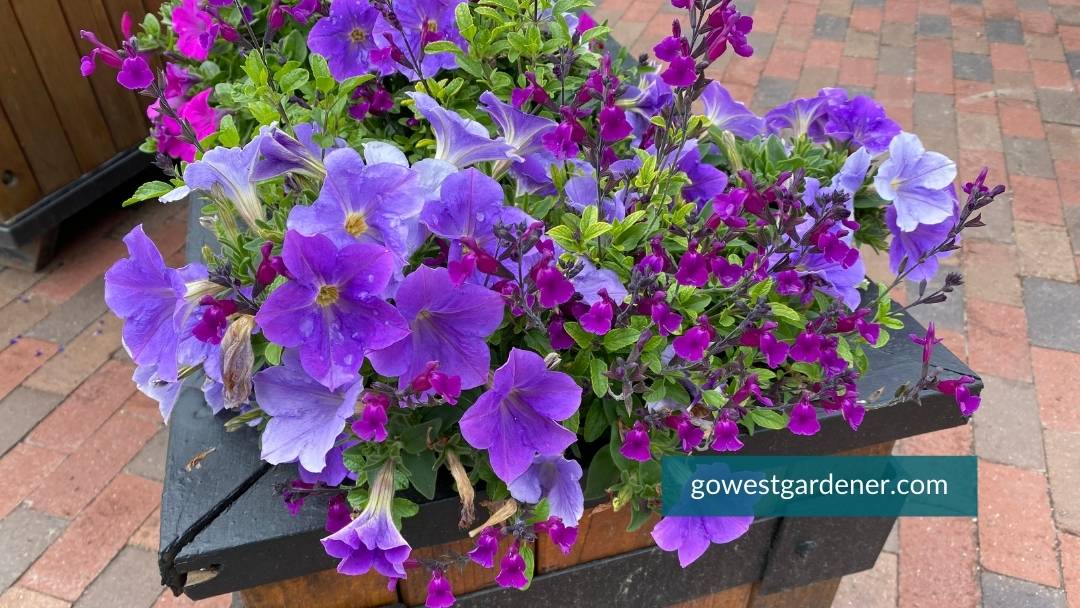
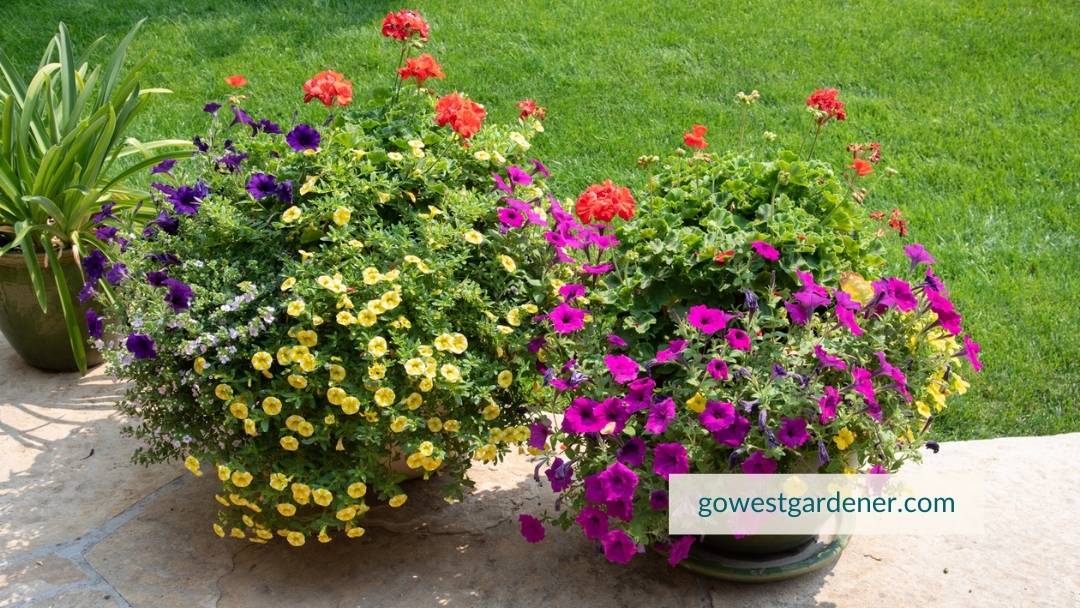
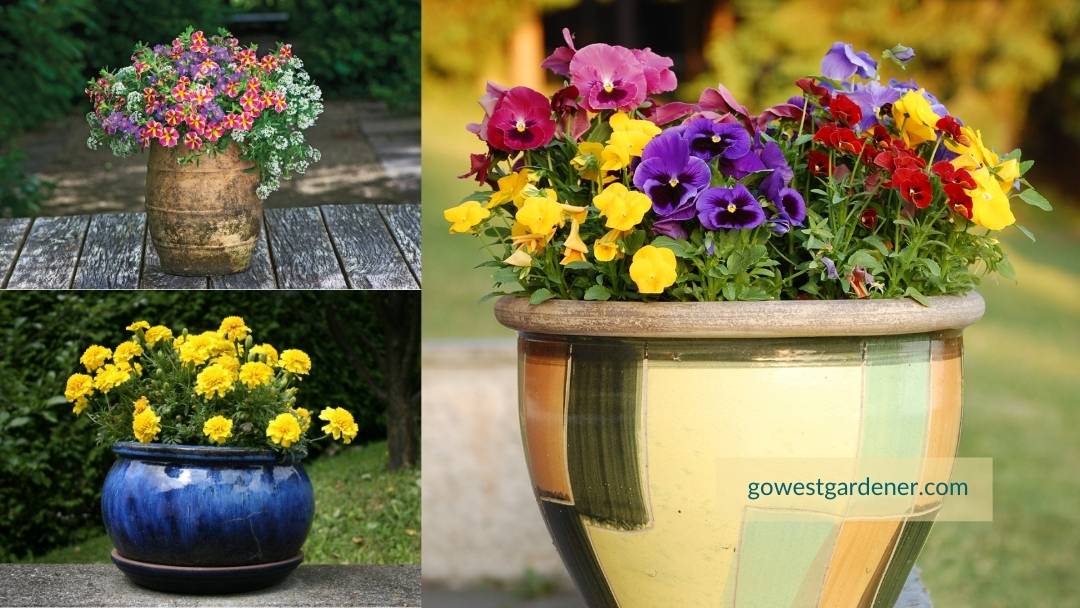
If you want flowerpots that are overflowing with color — like the vibrant containers you see in mountain villages or in town centers — then you’re looking for “annuals.”
Annuals are flowers that give you lots of color all summer long, but they don’t return next year.

The word annual is confusing because of how we use it in everyday conversation.
“Hey, we’re hosting our annual barbecue.”
We usually use it to mean recurring. But in gardening, annual actually means one and done. These flowers grow for one season, and then they’re done.
If you like word games to remember these types of phrases, here’s a helpful trick:
Annual = A single season.
So, when you go to your garden center, how do you know which flowers are the annuals?
Well, there are a couple of hints.
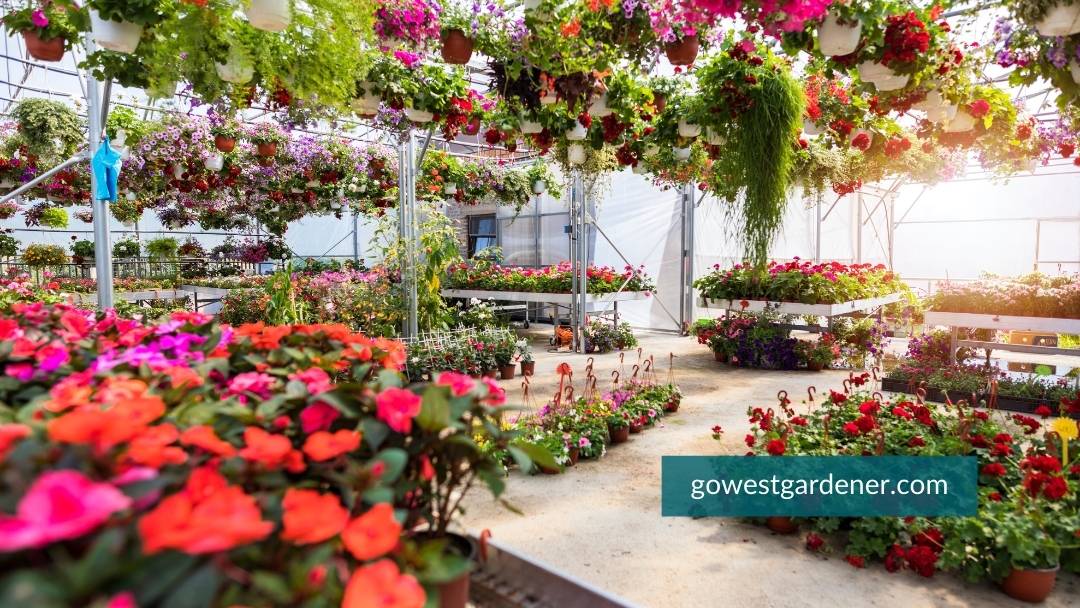
One, you may see a section of the store where it looks like the color dial has been cranked way up. There’s just so much color! Chances are, those are your annuals.
These flowers offer you big, showy color.
What’s another hint that you might be looking at the annuals section?
If you’re at an outdoor nursery, many of the annuals (and possibly all of them) are likely going to be located in a section with a cover or a greenhouse.
Annuals often need more moisture than perennials, so they’re typically in a section where the sun isn’t shining directly on them.
And of course, you can always ask:
- “Where are the annuals?” or
- “Where can I find the best flowers to grow in containers or pots?”
People are more than happy to point you in the right direction, so you know where to go.
Annuals may be the most popular flowers for colorful containers … But they aren’t your only options.
Let’s say, for example, you want to add scent to your flowerpots.
You could include herbs in with your flowers.
Or, let’s say you want to include plants that have interesting textures.
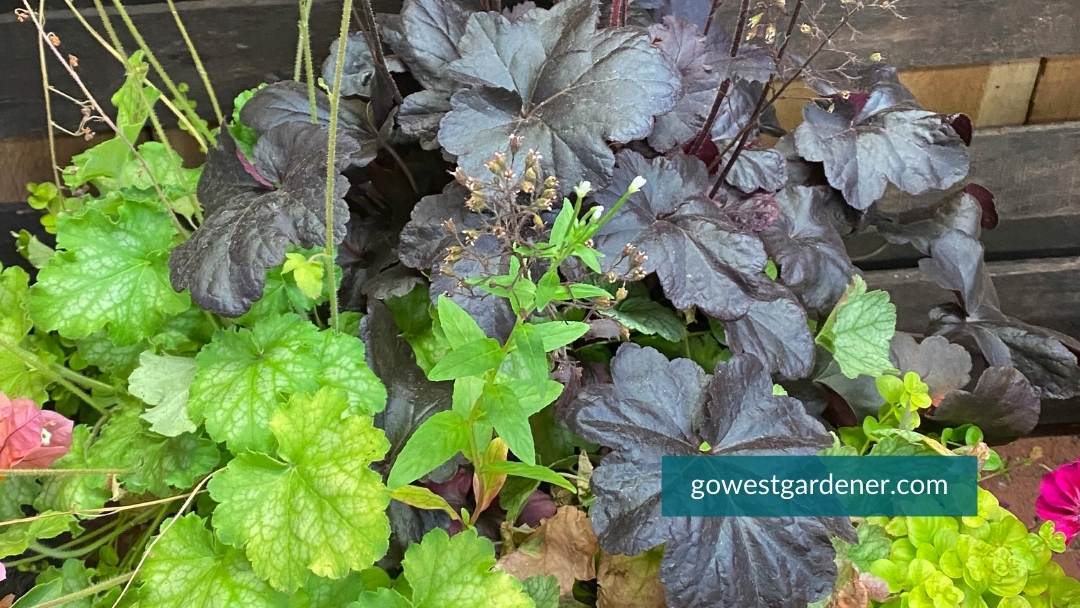
You could grow perennials in your flowerpots, like the container below with Coral Bells and Creeping Jenny.
Perennials are flowers that return year after year, but (usually) bloom for a shorter amount of time.
Many perennials bloom for a few weeks only.
So, if you plant perennials in your containers, most of them are not going to give you that big, showy color for the entire summer.
They’ll still be pretty, though, and they should give you interesting leaves and textures.
Here’s an example of how I use perennials in my containers.
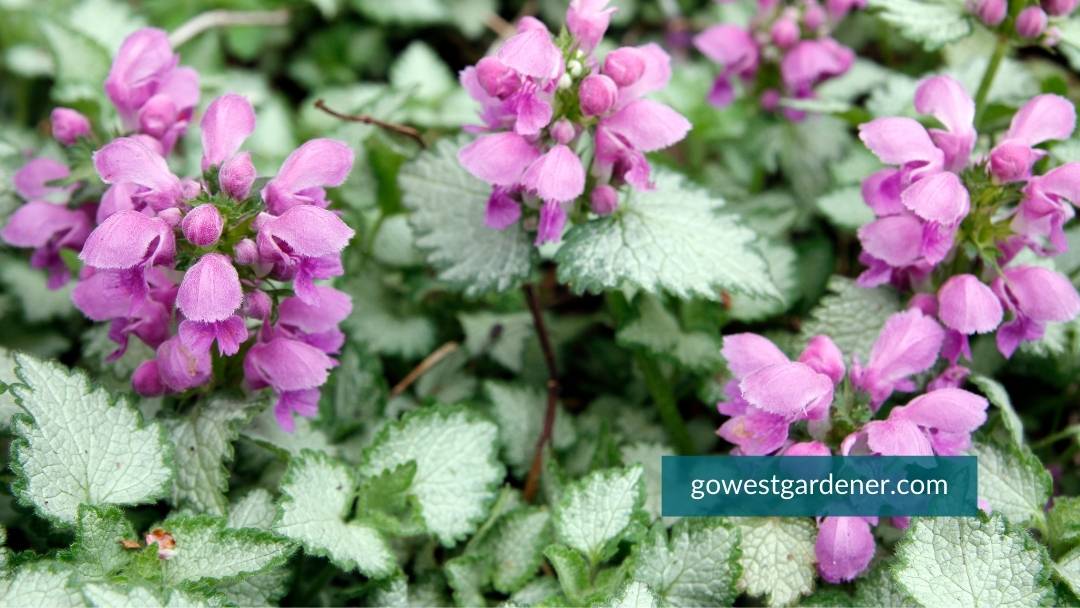
I like to plant lamium in some of my flowerpots. Lamium is a perennial.
It gives me flower blooms for some, but not all, of the summer.
I like to use lamium because its leaves are white. It’s unusual for a container garden. It’s a nice contrast with green-leafed flowers.
In the early fall, I can dig it out of my containers and plant it in the ground, so it can return next year.
Want to create pretty flowerpot designs like the ones you see at the garden center? Join the wait list for my spring training program: The Proven Flowerpot Formula.
Often times, perennials grown in containers won’t survive the winter.
It can be too cold on their roots. Too cold and hard. They prefer to be in the ground to return.
So, if you want your perennials to come back next year, simply dig them out of your containers in the late summer or early fall and plant them in the ground.
If you want big, showy color in your containers, look for annuals!
Related tips that may interest you:

by Ann at Go West Gardener | Updated: May 8, 2023 | Flower Garden Basics, Gardening Tips and Tricks, Western Container Gardening With Flowers
Buying flower plants at your local home improvement store is definitely convenient. But did you know you have other options on where to buy flowers for your garden in western states like Colorado, Utah and Wyoming?
Let’s say you’d like to find unusual flowers in additional colors …
Or more options for flowers that thrive in our tough climate (yes, please!) …
Or more plants that have been locally grown …
If yes, there are OTHER garden stores where you can buy flowers, including:
- Locally-owned garden centers. They specialize in plants for your home and garden. (Think of this like going to a dedicated wine shop to buy a bottle of wine.)
- Online retailers where you can order hard-to-find plants. They’re like Zappos for flowers.
In this article, you’ll get a high-level look at the pros and cons of different types of garden stores, so you can choose where to buy flowers for your garden in Colorado, Utah and similar western states.

Let’s take a closer look at your options.
Home improvement stores
(A normal starting point)
Plant selection:
- Your plant choices are limited … but if picking flowers feels overwhelming, a limited selection can be a good thing!
Types of flowers available for your garden:
- You’ll find common, popular flowers.
- Different flowers bloom at different times of the season. So, the store’s plant selection will change over the spring, summer and fall, depending on what’s flowering at that time.
Knowledge of staff:
- Hit or miss …
- Sometimes, you’ll find really helpful and knowledgeable employees. Other times, you may find employees “who normally don’t work in this department.”
- It depends on your store and who is working at the time.
Pricing:
- You can find inexpensive prices.
Guarantee:
- Some stores offer a one-year guarantee on perennials.
- If the plant dies in the first year, they’ll replace or refund it as long as you have the original receipt.
Pro tip: Ask if your store offers a guarantee on perennials. If they do, put your receipt someplace where you’ll remember it.
How to be a smarter shopper at home improvement stores:
(1) Be aware that some flowers and shrubs you’ll find are not an ideal fit for our semi-arid climate.
Some plants are a better fit for regions of the country that get more precipitation. This means you’ll need to give them a lot of water here.
Others just don’t do well in our soil conditions.
In the photo below, you’ll see an Endless Summer Hydrangea. My local home improvement store sells them every summer, and they are GORGEOUS in the store … but generally, they don’t thrive in Colorado gardens. It’s tough to recreate their blooms every year. They need a lot of water. And they need very acidic soil to give you blue flowers. (We have alkaline soil in the West, so their flowers are pink.)
(2) Watch out for plants that have grown too big for their containers.
Roots are growing at the same time that plants are growing, so the containers need to be big enough for that root growth.
Sometimes, plants outgrow the size of their containers. This means the roots have gotten too big for the pots.
When you remove the pot, you may see the roots are tightly circling the plant. This is known as “root girdling.” You’ll need to take extra steps to fix it (read: extra work), so your plant doesn’t strangle itself.
Pro tip: As a general rule, the size of the plant should be about equal to the size of the container. You may want to skip a plant if the pot looks small compared to the plant OR you see A LOT of roots coming out of the bottom of the container. You could be buying a problem.
In the photo below, you’ll see an example of a plant with a lot of roots growing out of the container. (Big red flag!) The roots were a matted mess. It also looked like the roots had been trimmed off. This plant was likely in this container for a long time. It would have been happier if it had been transplanted to a larger pot. Roots need room to grow. I decided to skip buying this plant.
(3) Sometimes, annuals and perennials are mixed together at these stores.
Annuals are the flowers that give you big, showy color for one summer, but they don’t return next year. Perennials are flowers that return year after year, but they normally bloom for a few weeks only.
If you’re unsure whether a plant will return next year or not, you may want to ask.
Local garden centers
(aka, “plant nurseries”)
Plant selection:
- You’ll find a good-to-extensive selection of flowers.
- This can be great for finding more “wow”-worthy flowers, but it also can feel a little intimidating on your first visit. (This feeling is 100% normal, by the way. It will go away as you build some momentum with gardening!)
Types of flowers available for your garden:
- You’ll find a wider range of flowers.
- You’re also likely to find seeds, bulbs, vegetable plants, indoor plants, shrubs, and/or trees.
- The flower selection will likely change over the spring, summer and fall, depending on what’s flowering (“in bloom”) at that time.
- Often times, many of these plants have been grown at local or regional greenhouses and farms. This means these plants may adjust better to our western growing conditions when you plant them.
Knowledge of staff:
- Knowledgeable (typically).
- Because these stores are specialized, there are usually employees on-site who can answer your questions.
Pricing:
- Their plants can be a little bit pricier, but not always.
- Keep in mind, quality and price can be related. These plants may be grown in better soil and have fewer issues with girdled roots.
- They may offer sales or special offers. (“Buy three, quart-size plants for just $x.”)
Guarantee:
- Some offer a guarantee on certain types of plants. Some don’t. It varies widely by garden center.
- If the store doesn’t mention it, it doesn’t hurt to ask!
- It also helps to save your receipt.
How to be a smarter shopper at local garden centers:
- Watch for plants that are too big for their pots: While this isn’t quite as common at local garden centers, it’s still important to be on the lookout for perennials that have a lot of roots growing out of the bottom of the pot or plants that seem much bigger than their containers. Remember, you may be buying a problem.
- Some flowers you’ll find don’t necessarily do well in Colorado and the West. As I mentioned above, some plants may need A LOT of water here. But this really depends on the garden center you’re visiting. Some stores are better than others in carrying western-friendly plants.
How to find local garden centers in your area:
- To find locally-owned garden centers, search for “garden centers,” “plant nurseries” or “plant stores” in [your city/town] on the Internet. These phrases may pull up some home improvement stores too. It depends on where you live.
- Here’s a list of local garden centers by city that carry Plant Select flowers. Plant Select is a western-friendly brand of flowers plants and shrubs created by Colorado State University, the Denver Botanic Gardens and local horticulturists. It’s a great brand for western states like Colorado, Wyoming and Utah because these plants tend to grow well in our western conditions, are hail resistant and are less work. (Can I get an amen?!) The Plant Select website lists where to buy these flowers. I’m just sharing this brand for your convenience.I do not make a commission.

Online retailers
(They’re like Zappos for flowers)
Plant selection:
- You’ll find unusual flowers and exclusive plants that are often hard to find elsewhere.
- Typically, they have a finite supply, so once they sell out of a plant, it’s gone for the season.
Types of flowers available for your garden:
- These stores often have a specialty, such as perennials, bulbs (like tulips), cut flowers (the flowers you see in wedding bouquets or centerpieces) and/or seeds.
Knowledge of staff:
- Knowledgeable (available by phone or email).
Pricing:
- It varies, but be sure to factor in shipping costs.
- They may offer sales and special offers (like free shipping) from time to time.
Guarantee:
- Some may offer a first-year guarantee if you follow their planting guidelines. They’ll replace or refund the plant if it doesn’t survive.
- If you’re interested in a guarantee, always ask whether the online store offers it.
How you buy flowers at these stores. It’s DIFFERENT than buying local:
- You indicate the type of plant you want from a website or print catalog.
- The individual plant is picked out for you.
- The plant is mailed to you — often on a schedule, such as a certain week of the growing season.
- The plant may be small to make it easier to ship.
- If your plant isn’t available, the company may substitute a different plant. (They’ll likely notify you first.)
How to be a smarter shopper online:
- Look for mail order companies that specialize in flower plants for the semi-arid West — like High Country Gardens based in Santa Fe, New Mexico. (I am not an affiliate for this company. I’m simply sharing it for your convenience.)
- If you are ordering plants from a company that’s based in another region of the country, keep in mind:
(1) Flower plants that thrive in the East, Midwest, South, Pacific Northwest and along the West Coast may not do as well in our high elevation, semi-arid, inter-mountain West.
(2) You likely need to read between the lines on flower descriptions because the descriptions may be written with the East Coast (and their climate) in mind. For example, their sun conditions are different than ours. The sun is more intense at our elevation than in other parts of the country. 6 hours of afternoon sun in Colorado can be like full day of sunlight in other regions. Other parts of the country also get more annual precipitation than we do, so we may have a different definition of what it means for a plant to be “drought tolerant.”
- Know that plants can get a little beat up in transit. See the photo below for an example of a flower plant I received from an online retailer. The before image shows how the plant arrived. The after shows what the plant looked like after I removed the broken pieces. (This plant grew like crazy and was thriving by mid-summer, so don’t let the first impression scare you.) As long as the roots are okay and you follow the planting instructions that come with your plant, your plant should be okay. Good roots are firm. They look white or creamy in color. (Poor roots are soft, mushy and brown.) If you ever have concerns, you can reach out to the online retailer’s customer support team.
How to find online retailers:
Yes, there are other places where you can buy flowers for gardens
… ranging from your local grocery store to Costco.
But if you’re just getting the hang of gardening in Colorado, you want to know where to buy flowers that last, AND you want to keep it SIMPLE, these are good options to get started.
Related tips that may interest you:

by Ann at Go West Gardener | Updated: Mar 7, 2025 | Flower Garden Basics, In-ground garden, Western Container Gardening With Flowers
As you start to learn more about gardening, you’ll likely find yourself playing a game of, “garden lingo bingo.”
And you will definitely see the garden terms, “annual” and perennial,” somewhere on your bingo card.
In this week’s tip, you’ll get the scoop on:
- What’s an annual vs a perennial
- A helpful trick so you can EASILY remember which is which
- Important differences between annuals vs perennials — and why those differences matter for your western garden
- Garden center tips so you can know how annuals and perennials are typically arranged at the store
What’s an annual vs a perennial?
If you find the word “annual” confusing, you are NOT alone!
In my opinion, the word “annual” is one of the most confusing gardening terms because of how we use “annual” in casual conversation:
“Hey, we’re hosting our annual summer barbecue. Come on over!
In day-to-day conversation, we use it to mean, “recurring.”
But that’s not what annual means in gardening. Here’s how gardeners think about it:
An annual flower plant grows for one season.
Then it’s done.
One and done.
Technically, a true annual flower goes through its entire life cycle within one year (from seed, to baby plant, to flowering, to end of life).
But gardeners are practical people.
They use the word, “annual,” to describe any plants that only last one year where you live. This includes flowers that could come back next year in some parts of the country, but these plants can’t survive our winters.
To keep it simple, just remember it all comes back to:
One and done.
In contrast, a perennial flower plant comes back year after year.
Some perennials live a LONG time.
My mom has perennials growing in her back yard that are more than 45 years old! I have perennials in my Colorado garden that have returned for 15+ years.
Other perennials have shorter lifespans of about 3-5 years. For example, many Penstemon plants (pictured below) tend to be shorter lived perennials in the West.
Here’s an easy trick to remember annuals vs perennials.
Annual = A single year.
Perennial = Plenty of years to come.
So, let’s chat about key differences between annuals vs perennials… and why they matter for your western flower garden.
Keep in mind that Mama Nature makes her own rules, so there are always exceptions. 🙂
How long until your annuals and perennials are full size

Annuals grow quickly, typically reaching their full size in one season.
Perennials, on the other hand, can take up to 3 years to reach their full size.
When you buy your cute, little perennial at the store, remember that it’s likely going to grow taller and wider. Look at the plant tags (tucked in the containers) to see how big your flowers will grow and how much room they’ll need when they’re full size. This can help you avoid planting your flowers too close together.
When you first plant your perennials, your garden may not look as lush and full as your neighbors’ gardens.
Don’t worry! This is normal. You haven’t done anything wrong.
Your garden will grow. It just may take a few years. While your plants are growing, you can tuck flowerpots of annuals into your garden for more color.
What to expect from the blooms of annuals vs perennials
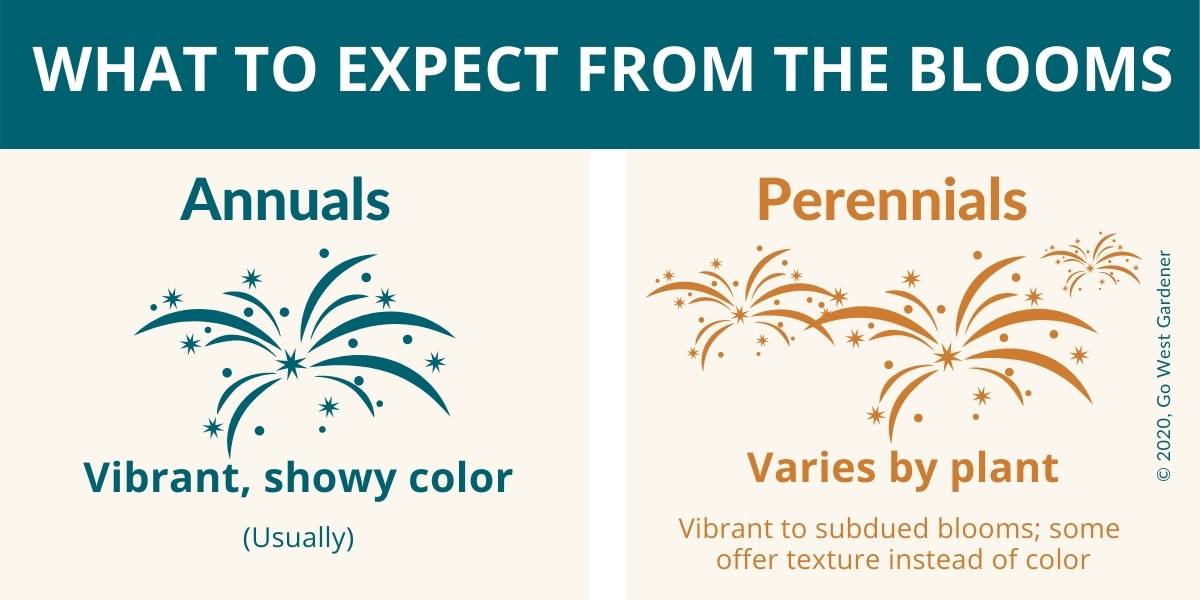
Annuals often give you big, showy color that goes on for a long time.
Typically, though, they don’t keep the same flower blooms for the entire summer. Instead, annuals push up flower blooms, those blooms die, and then new blooms come in. To help this process along, you may need to remove the blooms that have died. (In gardening lingo, this is known as “deadheading.”)
Perennials vary in how much color they give you. Most bloom for a much shorter amount of time, often just a few weeks. When temperatures are hot, flower blooms don’t last as long.
Where you grow annuals and perennials (typically)
You can grow annuals in containers, window boxes and in the ground.
In Colorado, we often get hail during the summer, so I prefer to grow annuals in containers, rather than in the ground. Annuals often need more water than the waterwise plants in my garden. Plus, I find it’s easier to move and protect my flowerpots when hailstorms are in the forecast.
Perennials are typically grown in the ground.
But can you grow perennials in containers? Yes, absolutely!
Just keep in mind that they’ll likely bloom for a shorter amount of time. Perennials also are less likely to come back next year if they aren’t planted in the ground. (Near the end of the growing season, it helps to take them out of your containers and plant them in the ground.)
Watering needs for your annuals vs perennials
Many annuals need quite a bit of water. (There are exceptions.)
Perennials, on the other hand, vary in their watering needs.
If you’ve moved to a western state like Colorado or Utah from another part of the country, you may discover that the perennials you planted elsewhere need A LOT more water here.
Rather than trying to plant flowers from other regions, a different option is to look for perennials that have adapted to our semi-arid growing conditions in the West. These “waterwise” perennials often thrive with very little watering once they’re established.
Read: Less work for you + happy plants!
How to find annuals vs perennials at your garden center
Many local garden centers will arrange annuals together and perennials together to help you keep them straight.
If you walk into a garden center and it feels overwhelming at first, you’ve got this! Remember that you can head for the annual section or the perennial section.
And if you notice one section of the garden center is WAAAAAY more colorful than others (like in the photo below), that is probably the annual section. Annuals give you big, showy color.
Sometimes, there aren’t signs, but people are happy to point you in the right direction.
So, don’t hesitate to ask!
(If you’re buying flowers at home improvement stores, they’re more likely to mix annuals and perennials together.)
Related tips that may interest you:
by Ann at Go West Gardener | Updated: Mar 27, 2024 | Flower Garden Basics, Western Container Gardening With Flowers
If you’re wondering, “Why should I plant flower pots this summer?”, here are 8 reasons to dig into this awesome hobby this year.
#1: Planting flowers reduces stress and makes you feel better.
Studies show that getting out in nature calms us and makes us feel better. DRAMATICALLY better. It actually has an effect on our brains. When we’re out in nature, our brains produce fewer stress hormones, and our positive emotions skyrocket. (Source: Health Magazine, “The Happiness Handbook,” March 2020.)
I love the idea that we’re not only creating beauty on our back decks, but we’re creating it in our brains too, don’t you?
#2: Flower pots are a great way to try gardening to see if you like it.
Flower pots give you a chance to try gardening without a huge commitment. Before you turn into a weekend warrior and dig up your front yard with grand plans of a Martha Stewart Living landscape, start with growing flowers in pots. They’re a great way to try flower gardening to see if you enjoy it. If you reach the end of the summer and it wasn’t your thing, no harm, no foul.
#3: Helloooooo, curb appeal! Flower pots are an easy way to make your outdoor spaces look GOOD.
You put so much care into the inside of your home. Why not put a little love into your front porch or back deck too? Planting flower pots can make your outdoor space as welcoming as your family room. You’ll LOVE stepping outside into your own beautiful escape.
#4: You can get big results in just one summer.
Planting an in-ground garden takes time, effort and investment. It can take perennials (the flowers that come back every year) up to 3 years to reach their full size — and even longer for shrubs and trees!
But growing flowers in pots? You can go from baby flowers to gorgeous, overflowing pots that have your neighbors saying “wow” in just one summer.
#5: Planting flower pots helps you get in touch with nature.
“I didn’t realize how out of touch with nature I was.”
It’s something I hear over and over again from budding gardeners when they reflect on what surprised them most about flower gardening. Growing flowers is therapeutic. There’s something grounding about putting your hands in the dirt and reconnecting with the earth.
#6: You want your quality time at home to be fun.
After a loooooong winter, it’s nice to spend time outside with something fun to do, right? This summer is the perfect time to try planting flowers or expanding your flower skills.
#7: It’s a fun activity to involve your loved ones and friends.
You may think of container gardening as a solo hobby. But I’m always amazed at all the fun ways to involve your honey, your kiddos or even your neighbors — from shopping for flowers, to caring for your flowers, to having neighbors stop and chat about your pretty creations. Growing flowers is a way to bring people together. Flowers are a magnet for connecting.
#8: It’s personally rewarding.
“I didn’t expect to enjoy growing flowers as much as I did. It was extremely fulfilling.”
This is another thing I consistently hear from flower lovers I work with! When your flowers look good, YOU feel good. You’ve brought this beautiful creation to life. Your effort has been worth it. And you’ll discover talents you never knew you had. It can be incredibly rewarding.
Related topics that may interest you:
by Ann at Go West Gardener | Updated: Sep 10, 2026 | In-ground garden, Western Container Gardening With Flowers
Looking for an easy-to-grow flower that gives you big, pretty color in the late summer?
I’d like to introduce you to Black-Eyed Susan (officially, Rudbeckia — Rude-bek-ee-uh). It also goes by the name: Gloriosa Daisy.
There are many reasons to love this flower.
In this article, we’re going to chat about why Black-Eyed Susan plants can be great flowers for late summer gardens in the West.

More than a month of colorful blooms? Yes, please!
If you’re new to Black-Eyed Susan, it’s a showy flower that resembles a daisy.
It often has gold or yellow petals and a black, brown or green center.
Typically, in states like Colorado, it will bloom in late July, August and even early September, so it gives you pretty color when a lot of other flowers are done blooming.
The exact bloom time depends on where you live.
Here are reasons to include these pretty flowers in your western garden:
- They’re bright and showy, adding a BIG pop of gold color to your garden in mid- to late-summer.
- They bloom for a looooong time. You may get up to 2 months of color.
- Some grow well in mountain gardens, as well as down at lower elevations.
- They tend to be adaptable to our tricky western soils, from clay soil, to sandier soils.
- They grow well in the sun, but some will tolerate places in your garden that get a mix of sunshine and shade.
- Some are drought tolerant once they’re established. (Ideally, though, many of them prefer moderate water. You may want to plant them near a downspout or in a low area that stays more moist.)
- They don’t like a lot of fuss. They’re usually happier without things like fertilizer.
- They tend to be deer-resistant, meaning these plants aren’t Bambi’s first choice for breakfast.
Translation: This is an easy-going, low maintenance plant for western states like Colorado and Utah.
And cheers for plants that aren’t a lot of work, am I right?
But here’s what doesn’t always get mentioned…
Some types of Black-Eyed Susan are shorter-lived than others.
I share this with you because if your plant doesn’t come back, you may think you did something wrong.
But nope, you may have just purchased a shorter-lived Black-Eyed Susan! Find out how to tell them apart here.
Related topics that may interest you:
by Ann at Go West Gardener | Updated: Jan 28, 2026 | Gardening for Pollinators, Gardening Tips and Tricks
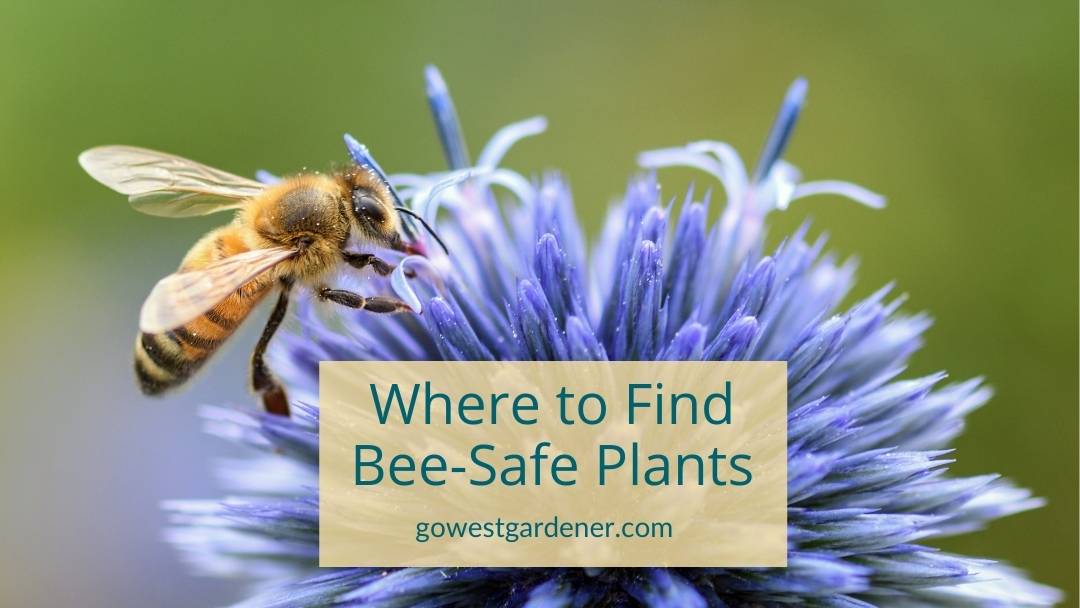
Did you know that flowers and plants from the garden center often have a pesticide in them that can be toxic to bees?
“What, whaaaaaaaat?”
That pretty much sums up my reaction when I realized that my last impulse purchase was harmful to bees.
If you want to create a pollinator garden, here are helpful things to know about the commonly-used pesticides known as “neonicotinoids.” You’ll also find tips on where to buy plants that are safe for bees in Colorado and similar western states.
I first learned about neonicotinoids and “bee-safe” plants at the 2021 Colorado Pollinator Virtual Summit. This annual event is open to the public and is typically offered in the fall.
Many plants sold at garden centers have been treated with neonicotinoids (or “neonics,” for short).
Neonicotinoids are a “systemic insecticide”—a type of pesticide.
This means plants absorb the chemical into all of their plant tissues to kill insects. Even their nectar and petals!
Many growers use neonics early in a plant’s life cycle to help control pests.
It’s very common.
Unfortunately, these insecticides can stay in your plants for a long time. (Sometimes years!)
The chemicals can be passed along to bees when they land on or feed from that plant.
Neonics can lead to a range of problems in bees—like weakness, disorientation and impairment… and even death.
Yikes.
For example, studies have found that bees that have been exposed to neonicotinoids have a:
Social bees—like honey bees and bumble bees—also have reduced social activity and a reduced ability to regulate their nest temperature.
So, how do you know whether a plant is neonicotinoid free or not?
Well, this is where things get tricky.
It isn’t easy to tell.
For now, a good place to start is to learning where to buy plants that are safe for bees.
If you live in the Front Range of Colorado…
There’s a local website that keeps a list of where to buy neonicotinoid-free plants (source: Sustainable Neighborhood Network).
The garden centers, plant nurseries and growers on this list have self reported that their plants are neonicotinoid free.
I learned about this resource through the Colorado Pollinators Virtual Summit. I’m sharing it in good faith, but please understand there is no guarantee of its accuracy.
As you’ll see noted on the nursery list, it’s always a good idea to double check with a store manager to make sure this information is accurate.
If you want to buy plants that are safe for bees online…
Check out High Country Gardens.
High Country Gardens has self reported that all of their perennials and wildflower seeds are neonicotinoid free.
Originally from Santa Fe, New Mexico, this online retailer carries many western plants.
If you live someplace else and want to buy local…
Skip the big box stores.
Instead, “you may be more likely to find organic plants at small local nurseries, native plant nurseries or at a farmers market,” says the Xerces Society, a science-based conservation organization, in their Buying Bee-Safe Plants Guide.
You also can call or visit your local, independent garden center and speak with a manager.
For tips on what to ask and how to have a conversation, please refer to the Buying Bee-Safe Plants Guide above.
Just be aware that the store managers may not know whether their growers use pesticides, like neonicotinoids.
Another option on where to find plants that are safe for bees…
Consider growing your plants from seeds.
When you buy seeds, look for the USDA Certified Organic label on your seed package.
That way, you’ll know the seeds meet federal organic standards. In other words, the seeds shouldn’t have been treated with neonicotinoids.
More about the annual Colorado Pollinator Summit
Attending the Colorado Pollinator Virtual Summit was an eye-opening experience for me.
I learned A LOT.
The summit included speakers and partners from organizations like the Butterfly Pavilion, Denver Botanic Gardens, Colorado State University (CSU) Extension, Denver Audubon Society, Colorado Pollinators Network and more.
This annual event is open to the public. If you’d like to attend the next Colorado Pollinator Summit, make a note on your calendar for the early fall, so you can search for the upcoming event and get tickets.
Related topics that may interest you:
by Ann at Go West Gardener | Updated: Nov 17, 2023 | Garden design Ideas, Gardening Tips and Tricks, In-ground garden, Waterwise Gardening in the Intermountain West
Walk among the flowers and feel your stress lift away!
Visiting a local botanical garden is a wonderful way to relax in nature and find inspiration for your own garden. Many local botanical gardens feature beautiful flowers, shrubs and trees that grow well in our tricky, semi-arid climate.
Here are links to many public gardens in the intermountain west, so you can find a botanical garden near you.
Botanical gardens in Colorado
Colorado also has waterwise demonstration gardens and native plant gardens. These gardens can be good places to see examples of natives plants and drought-tolerant plants.
Here are a few demonstration gardens along the Front Range:
You may want to search for waterwise demonstration gardens in your area.
Botanical gardens in Utah
Botanical gardens in New Mexico
Botanical gardens in Idaho
Botanic gardens in Wyoming
Botanic gardens in Montana
If you don’t see your state listed above, simply search for phrases like:
- Botanic gardens near [your city or state]
- Best gardens in [your city or state]
The American Horticulture Society has a search feature on their website to help people find botanical gardens that welcome members from other gardens. I find their search tool useful if you want to find botanical gardens by state. They don’t list every garden, but they include a lot of them.
You also can search for “demonstration gardens” near [your city or state]. Often times, demonstration gardens are good places to get ideas for waterwise (drought-tolerant) plants for your garden.
by Ann at Go West Gardener | Updated: Mar 7, 2025 | Gardening Tips and Tricks, Western Container Gardening With Flowers
I’ve been feeling conflicted about sharing this week’s gardening tip.
I firmly believe that you do not need a lot of stuff to be a successful gardener.
When I moved into my home, I was fortunate to inherit a few, basic gardening supplies from the previous owner. She was downsizing to a townhouse and was ready to say goodbye to her small collection of shears and shovels. I still happily use most of her tools and supplies today.
But every now and then, I’ll reach a point during the gardening season when I think:
“It sure would be nice to have…” a cute (but affordable) flowerpot, hail netting, etc.
What I’ve discovered is:
Some garden supplies can be surprisingly hard to find when you need them during the garden season.
Others are time-sensitive.
So, in this week’s tip, I want to share a few items that are helpful to track down NOW, rather than waiting until summer.
Do you prefer to find used garden supplies rather than new ones? Awesome! I’ve included “reuse” ideas too.
Packets of flower seeds
If you’ve played with the idea of planting flower seeds this year, now’s a good time to shop for them. For just a few bucks, you can grow really pretty flowers in your garden from a packet of seeds. And there are many flower seeds that you can spread directly in the ground — like the colorful Cosmos flowers below.
No fancy growing equipment needed!
What’s the catch?
Your timing matters. Your flowers are more likely to bloom when you want them to bloom — like in July and August instead of October! — when you follow the recommended timing for planting your seeds.
Often times, these seeds need to be planted 2 to 4 weeks before your “average last frost date.”
What’s an “average last frost date?” What does that mean? It means this is the point when there’s now less than 50% of a chance of getting a frost. You can search online to find the average last frost date for your area.
In Denver, our average last frost date is in early May. If we need to plant 2 to 4 weeks before this date, it’s best to plant these seeds in early- to mid-April.
Other seeds need to be planted even earlier.
You can find flower seed packets at local, independent garden centers. You also can buy seeds directly from seed companies like Botanical Interests. They’re a Colorado company. (This is not an affiliate link. I’m just sharing it for your convenience.)
Look at the back of the seed packets — or read the online descriptions — to find out when you should plant your seeds for the best results.
Affordable flowerpots
I’ve come to appreciate that flowerpots are like a nice pair of shoes or a stylish piece of jewelry. They can really elevate the look of a container garden.
They also can be surprisingly expensive.
If you’d like pretty flowerpots without the shock-inducing price, now’s a great time to look for flowerpots at stores like HomeGoods (TJ Maxx) and even Costco.
If you prefer to re-use rather than buying new:
- Look for used flowerpots on Next Door, OfferUp and Craig’s List.
- Check out estate sales. They’re another good place to find outdoor treasures like flowerpots and garden tools.
Pro tip! When choosing a flowerpot, look for pots that have hole(s) in the bottom. A flowerpot without a hole is like a bathtub without a drain. You’ll save yourself extra steps later when you buy a pot that already has a hole in it.
Hail netting
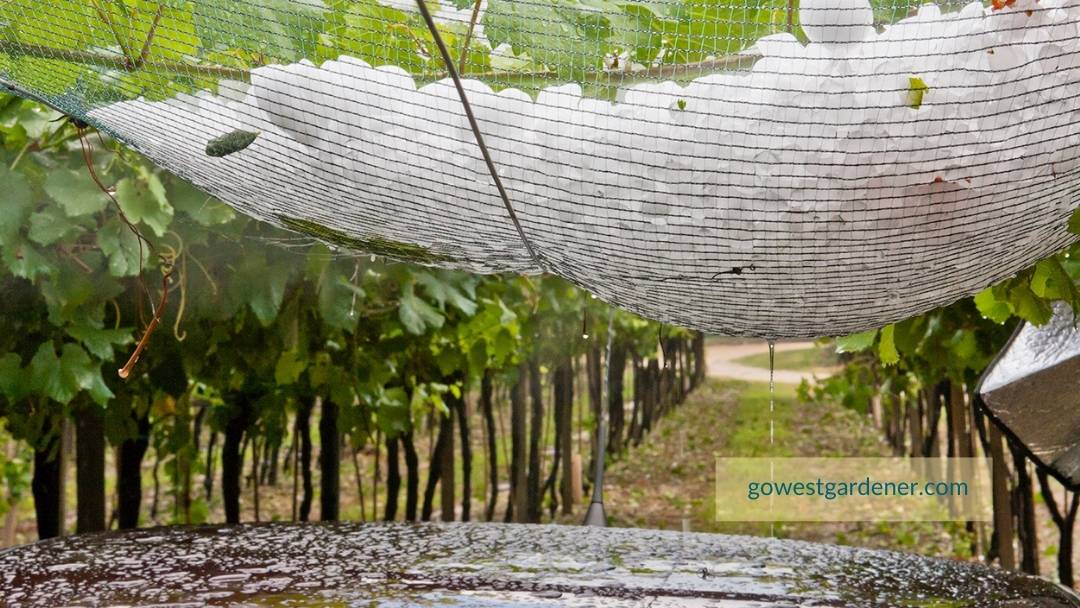
I know this is a weird one for March. But while we’ve been shoveling snow, scrappy gardeners have been proactively searching the Internet or visiting local garden centers for supplies like hail netting (also called, “anti-hail netting”).
This is one of those items that when we roll into thunderstorm season, the demand is so high, it’s usually sold out.
Translation: When you need it, you can’t get it.
By the way, there are plenty of things you can use in your home to protect your flowers from hail. I have a friend who uses shower curtain liners to help protect her flowers from hail. You can get creative.
So please know, you do not need to buy hail netting.
With that said, now’s the time to look for hail netting if a hailstorm trashed your flowers last year and you want to up your hail protection game. Sometimes, you can find hail netting at your local, independent garden centers. You also can find it online from garden supply companies and Amazon.
Related topics that may interest you:
by Ann at Go West Gardener | Updated: Jan 28, 2026 | Gardening Tips and Tricks, Western Container Gardening With Flowers
So, you walk into your local garden center …
You’re all ready to pick 3-5 flowers for your planters, but suddenly, you see HUNDREDS of flower choices.
You’re looking at row, after row, after row of flowers.
How are you supposed to know which flowers to pick??
No worries, you’ve got this!
In this tip, you’ll discover 4 proven questions to help you start narrowing down your choices, so you can pick flowers for your planters that are more likely to last — particularly in our tough western growing conditions.
Watch my video below or scroll down for the article.
Here’s what to think about when picking flowers, so your flowers are more likely to last — particularly in tough western states like Colorado and Utah.
#1: How much sun will my planters get where I place them?
Some plants love the sun. In fact, they need the sun in order to give you colorful blooms.
But other plants?
Not so much.
They actually prefer shadier conditions.
Before you go to the garden center, take a look at where your planter will be and ask yourself:
How much sunlight are my pots getting and what times of day?
That way, when you get to the garden center, you can look for flowers that love sun or flowers that prefer shade.
Look at the plant tags tucked in the flowers. The plant tags should tell you whether the flowers like sun, shade or something in between.
If you’re ever unsure of how much sunlight different flowers need, you can always ask at the garden center. People are usually happy to help you.
In western states like Colorado and Utah, our sunlight is more intense on our plants in than other parts of the country because we’re gardening closer to the sun at elevation.
#2: The next question for you is, do you have wildlife in your area?
And specifically, I mean deer.
Here’s why I ask.
Some plants have developed defense mechanisms, so they’re less likely to be eaten by deer.
For example, they may have a scent or a taste that deer don’t like.
If you know that Bambi and his friends like to stroll through your neighborhood like it’s an all-you-can-eat lunch buffet, be sure to ask where the deer resistant flowers are when you go to the garden center.
(Sometimes these flowers are grouped together at the garden center. Sometimes they aren’t.)
The key word here is “deer resistant.”
If an animal is hungry enough, it will eat anything that’s available to it.
Nonetheless, you’ll give yourself a little bit of an advantage if you know that your neighborhood has deer, and you seek out deer-resistant flowers.
Okay, next question:
#3: Do you get really hot summers? Or are you more likely to get summer frosts?
Here’s why I ask.
Some flower plants do really well in the heat. They can handle it like a champ, like the zinnias below.
Other flower plants prefer cooler temperatures and are happier in sweater and jeans weather.
In fact, when temperatures get down around freezing, they’re going to be a lot more forgiving than some other plants (like pansies or violets below).
Seldom are these two the same.
So, if you know you live somewhere hot and you’re putting your flower plants out in the afternoon sun, then you want to ask for “heat tolerant” annuals or “heat resistant” annuals.
But if you know that you live at a higher elevation with a much shorter growing season and you have the chance of much colder temperatures, then you’re more likely to want to ask for “frost tolerant” annuals or “cold hardy” annuals. These are your flowers that are more forgiving at colder temperatures.
Okay, last question to ask yourself to set yourself up for more success with your planters or pots.
And it’s this:
#4: How much energy do you want to put into growing flowers?
All flowers need a little bit of your energy, right?
You need to water your flowers.
You may need to remove the dead blooms.
And you may need to fertilize them from time to time.
But, if you know you’re not-so-great about watering or you’re not-so-great at removing those dead blooms, there are actually flowers you can choose that are almost designed for you.
For example, let’s say that the idea of trimming off dead blooms on a flower sounds like a lot of work to you. (This is known as “dead heading.”)
Well, did you know there are some flowers that lose their petals on their own?
Often times, they’re called “self-cleaning” flowers. They lose their blooms and take care of it all themselves, so you don’t have to do a thing.
When you look at flowers at the garden center, look for words like “self cleaning” or “no deadheading” on their plant tags. (Not every plant tag says it, so it’s okay to ask about self-cleaning flowers too!)
If you know you’re not so great about watering…
You may want to ask about flower plants that need less water.
Or, you may want to invest in planters that contain self-watering reservoirs. You could run mall hoses from your irrigation system (known as “driplines”) straight into your planters or pots.
There are things you can do to pick plants that are much more suited for your lifestyle.
Related tips that may interest you: