by Ann at Go West Gardener | Updated: Jun 20, 2025 | Best Flowers for Colorado, Utah & Similar States, Flower Garden Basics, In-ground garden, Waterwise Gardening in the Intermountain West
If you’ve been wondering, “Where can I learn about plants for waterwise flower gardening?”, you’re in the right place.
It’s dry in the West, which means we need to be strategic about the flowers we grow in our gardens.
Where I live in Colorado, we’re lucky if we get 14″ of moisture per year. Depending on where you live, you may get even less!
Just to put that in perspective, Seattle and Chicago get close to 40″ of moisture per year. Boston gets about 44″ per year. And Atlanta and Orlando get around 50″ per year.
So, what is waterwise flower gardening?
Generally, waterwise flower gardening means two things:
- You intentionally choose flowers that don’t need as much supplemental water to grow. (No need to use the sprinkler today!) You may hear these plants called “drought-tolerant” or “low water” flowers.
- You group plants together that have similar watering and sunlight needs. For example, plants that need less water and a lot of sunlight go in one section of your yard. Plants that need more water go in a different section of your yard. That way, you’re being efficient with your irrigation.
While drought-tolerant flowers may make you think of cacti, rest easy, there are many beautiful flowers that grow well with less water.
They just may not be the flowers you know from other parts of the country!
To help you learn about waterwise plants, here are 4 useful resources.
I’m sharing the links below for your convenience only. You may be able to find the books locally.
1) “Waterwise Plants for Sustainable Gardens” (book)
Lauren Springer and David Ogden are western flower gardening experts. They have a wonderful book called: “Waterwise Plants for Sustainable Gardens.”
This is one of my go-to books for waterwise flower ideas.

It’s filled with photos and helpful tips that can be used whether you’re a beginner, intermediate or advanced gardener.
This book contains plant ideas for different regions of the semi-arid West, including the West Coast.
Pro tip: As you go through the book, make sure that the flowers you like match your plant hardiness zone. A plant hardiness zone tells you whether a plant is likely to survive the coldest winter temperatures that are expected in your area. Some of the flowers in the book may be better suited for parts of the West with warmer winters.

2) “Pretty Tough Plants” (book and website)
Wouldn’t it be nice if someone actually tested which low-water plants grow well in the intermountain west?
Good news, there are people that do!
Plant Select is a western plant introduction program. They introduce smart and sustainable plants that are inspired by the Rocky Mountain region. (They’re a non-profit collaboration between Colorado State University, Denver Botanic Gardens and the western green industry.)
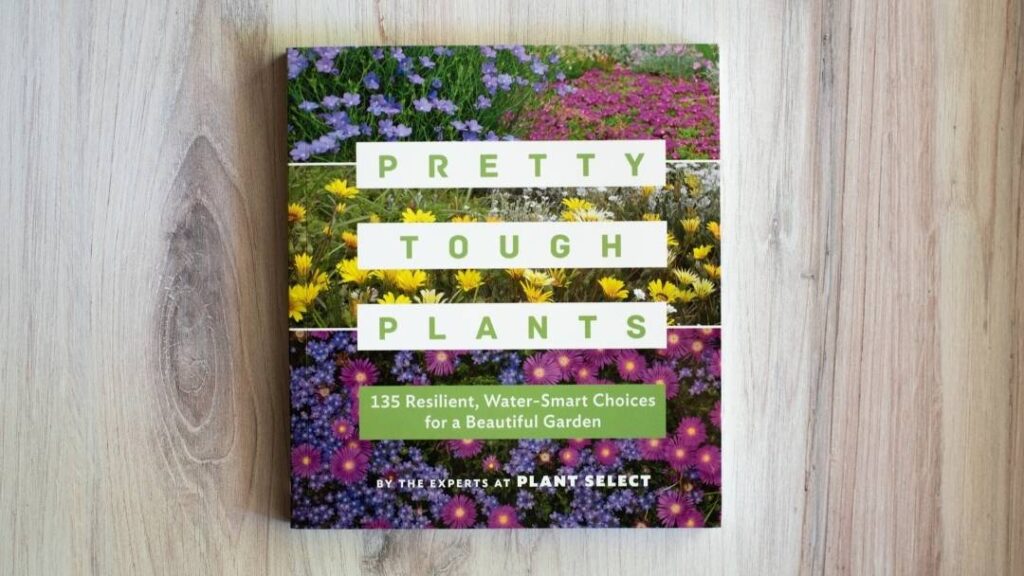
Plant Select has a GREAT book called “Pretty Tough Plants.”
I refer to this book all the time. It’s another book that is user-friendly for gardeners of different levels. My understanding is this book is no longer in print, so if you can find a copy online, snag it!
Do you prefer online resources, rather than books?
You can see photos and descriptions of all the Plant Select flowers on their website, including both flowers and shrubs.
And if you’d like to see these flowers in person…
You can find Plant Select demonstration gardens across Colorado and in some additional western states.
I’ve visited a number of the demonstration gardens in the metro Denver area. My favorite Plant Select garden is at Denver Botanic Gardens Chatfield Farms. It’s beautiful.
I’ll share upfront, some demonstration gardens are better than others, and the plants aren’t always marked.
So, if you’re just getting started with waterwise gardening, my suggestion is to visit the Plant Select demonstration gardens at your local botanic gardens. That way, you can ask what a flower is if you like it. We’ll chat about plant identification apps in a future tip, but you can always try identifying plants with plant ID apps too.
3) Online workshops, videos and low-water plant lists
Colorado Springs Utilities has a number of helpful resources on gardening with less water.
On their waterwise plants website, you can find links to:
- A variety of online workshops, including a video called “Waterwise Landscaping for Beginners”
- Photo galleries of waterwise landscapes
- Low-water plant lists
While the online workshops are tailored to Colorado Springs residents, many of their waterwise gardening tips are relevant well beyond.
This is a website worth checking out, regardless of whether you live in Boulder, Boise or Cheyenne.
4) Native plant lists and tips
Native plants are plants that have occurred naturally in a region. They were there before European settlement. They’ve adapted to local growing conditions, and they can provide great habitats and food sources for birds, insects, etc.
Many native plants are drought tolerant. (Though, not all of them.)
If you’d like to learn more about drought-tolerant native plants, your state probably has a “Native Plant Society.”
Here are the native plant societies for the intermountain west:
If you don’t see your state listed above, simple google: [Name of your state] Native Plant Society.
In Colorado, the native plant society has a dedicated resource page for gardening with native plants in Colorado. You’ll find their plant guides for every region in the state. For example, they have suggestions for low-water, native plants for the Front Range of Colorado. You’ll also find their recommendations for flowers to avoid planting because they can be invasive.
Related topics that may interest you:

by Ann at Go West Gardener | Updated: May 20, 2026 | Flower Garden Basics, Western Container Gardening With Flowers
Wondering how to get started with flowerpot gardening?
Pop in your ear buds, find a comfy spot and listen to this 30-minute episode of the @liveblissedout podcast!
I was honored to be a guest and chat about flowerpot gardening in Colorado, Utah and the West. Click the blue play button below to listen.
In this flower gardening podcast, you’ll discover:
- How to feel more confident growing flowers — even if you’ve struggled or you’ve never grown a flower before
- What to think about when choosing flowers for pots, so your flowers live longer
- How to INSTANTLY make your flowerpots prettier
- How to know how many flowers to buy, so you don’t waste money
- Where to buy flowers if you like unique flower blooms (beyond the home improvement stores)
- And more!

The Live Blissed Out podcast is an educational variety show focusing on how you can achieve happiness through awareness and taking action. I loved being a guest.
Related tips that may interest you:

by Ann at Go West Gardener | Updated: May 20, 2026 | Gardening Tips and Tricks
What the heck is turning your plants into lace-y skeletons?
If it’s late June, July or August in the Front Range of Colorado, Japanese beetles may be to blame.
“What do Japanese beetles look like?” you may be wondering.
Japanese beetles are metallic green insects with dark orange wings, making their backs look metallic orange. They have white spots along their sides.
And they will eat their way through your yard with reckless abandon.
Japanese beetles are spreading along the Front Range of Colorado, including the metro Denver area, parts of Pueblo, Boulder and Fort Collins.
So, what can you do about Japanese beetles?
It’s 100% normal to go out and buy the first products you see to get rid of Japanese beetles.
But, while these products may be well intentioned, many have not proven to be effective in reducing damage on your plants. You may be throwing away good money.
And some products are very toxic to the good insects in your garden, like bees. You may be unintentionally nuking your own garden.
In this video about Japanese beetles, you’ll get:
- A basic introduction to Japanese beetles, so you know what to expect
- 2 primary ways to think about Japanese beetle control, so you use your time well
- A look at some of the plants they REALLY like
- Myths about ways to get rid of Japanese beetles, so you don’t waste your money on products that don’t work
- A more detailed resource, if you want it, that includes Japanese beetle control products on the market
Prefer to read?
Scroll down for the transcript.
I’ve also included helpful resources at the end of this article, including different products you can use to control the beetles.
Transcript of Japanese beetle video:
Japanese beetles in Colorado.
They’re working their way up and down the Front Range.
These beetles can be a royal pain in the bootie for your flowerpots, your garden, your trees and even your lawn.
So, in this video, you’re going to find out what you should know about Japanese beetles in Colorado and how to control them.
[music]
Hi, I’m Ann with Go West Gardener.
Inspiring new western gardeners to find their green thumbs with flowers.
Real quick, in addition to my 15 years of hands-on experience with gardening in Colorado, I’ve completed more than 120 hours of formal training in western gardening, and I continue to take courses and workshops, so I can help you with topics like the one today: Japanese beetles in Colorado.
Unfortunately, Japanese beetles are here to stay along the Front Range. So, it’s helpful to plan ahead and know what your options are.
In this video, I want to give you:
- A basic introduction to Japanese beetles because there’s A LOT of misinformation out there.
- I’m going to share 2 primary ways to think about Japanese beetle control.
- I’m going to debunk some myths about ways to get rid of Japanese beetles. (And yes, you will see your neighbors doing these things.)
- And I’m going to point you to a more detailed resource, if you want it.
Let’s jump in.
Japanese beetles go through a one-year life cycle, but if you have a yard you care about, the real “joy” with beetles comes in the second half of the summer in Colorado.
Around the very end of June or early in July, the adult beetles will emerge from your lawn and start showing up on your plants.
And now they’re ready to eat their way through your garden in July, August and sometimes early September.
Japanese beetles have two priorities:
- To eat and
- To reproduce
If you had them last year, you know they will chew their way through your plants, creating holes in your plants and turning them into lacey skeletons.
Depending on the plant, they may eat the flower petals, they may eat the leaves, or they may eat both.
And between their dinner parties on your plants, the females will fly down to your lawn, dig a few inches down to lay eggs, and then come back up and start the process all over again.
So now, you don’t just have the adult beetles to think about, you have their babies too.
As the eggs hatch, the larvae — which are these little white grubs — will feed on the roots of the grass in your lawn.
And they’re especially fond of lawns that we have along the Front Range of Colorado, like Kentucky bluegrass, fescue and ryegrass lawns.
So, picture this…
You’ve got the adult beetles chewing on your plants above ground, and you’ve got their babies — these little white grubs — chewing on the roots of your lawn.
Not a good time!
As temperatures drop, the grubs will dig deeper into your soil for the winter and then come up closer to the surface again in the spring before they emerge as adult beetles in late June and early July.
So, if we’re going to talk about how to control Japanese beetles in Colorado, it helps to think of them as affecting your yard in two ways:
- You’ve got the adults eating your plants, and
- You’ve got the grubs chewing on the roots of your lawn
From a control and treatment perspective, you can deal with the adults, and you can deal with the grubs.
Let’s talk about how to control the adults that are eating your plants.
One of the biggest things you can do to PREVENT damage is avoid planting flowers and trees that Japanese beetles love in Colorado.
These are plants like roses, Virginia creeper (it’s a vine you’ll see growing along fences), linden trees and some types of fruit trees.
I had a plum tree that the beetles would just fall out of and land in your hair, like the tree was dripping with insects.
It was so gross.
And that’s just the start of what they like to eat.
Every year I feel like I find them on something new.
But let’s say you absolutely love a plant, like roses, and you want to plant them.
Then just know that your roses will look great early in the summer, the beetles will try to chew them up in the middle of the summer, and then, it’s possible your roses may give you flowers again in the early fall after the adult beetles have died.
Now, you may be thinking, so prevention is great, Ann, but I have beetles NOW.
“What can I do about them?”
“How do I get rid of them?”
“Can’t I just spray them?”
Yes, there are insecticides and some bio-controls you can use to kill Japanese beetles.
But do your research because many of these also have a negative effect on bees and other pollinators — the really good insects in your garden that we need.
Later in this video, I’m going to share a resource where you can find a list of product options for you on what you can apply to your plants, including how toxic they are.
If you DO have beetles and you DON’T want to use poisons, one of the most effective things you can do is to put on a pair of garden gloves, put together a container of soapy water, and then knock or pick and drop the beetles into the soapy water to drown them.
(This works with small amounts of beetles.)
Dig through your recycling bin to find a container you can use.
I will often save an empty, plastic butter container that I fill up with soapy water.
I plop the beetles in and then put the top on until I know they’re dead.
Once the beetles are dead, you can throw them out in your trash, you can compost them, you can even bury them — they won’t cause any harm at that point.
When the beetles are chewing on your plants, your plants are releasing a compound that’s like a magnet to more beetles.
For me, this always makes me think of the local ice cream truck.
On summer nights, it comes cruising through our neighborhood, playing that distinctive musical jingle, and the kids come running to it.
So, your plants are basically doing the same thing as that ice cream truck playing that song, and the beetles don’t want to miss it.
Here’s what this means.
It’s better to get the beetles early before you have a feeding frenzy on your hands.
If your plants haven’t been damaged too much yet, it’s like the ice cream song is really quiet. But if you wait until your plants have a lot of damage — the music will be blaring and more beetles will come.
Beetles are groggiest at cooler times of the day and when it’s darker, like in the evening or early in the morning, so those are the best times to try to pick them off your plants.
If you try catching them during the day when it’s warm, they’ll quickly fly away. I have to say, this doesn’t stop me from trying to catch them, but I often miss many of them.
Okay, so that’s one option.
You can pick off the beetles by hand.
But let’s say you have A LOT of beetles, like on your roses or on your vines.
I recently took a Colorado gardening course where the speaker was talking about using a shop vac to vacuum up the beetles from the vine that the beetles were eating.
I have not tried this, but it sounds interesting if you have too many beetles to pick off.
And you know what I’m talking about when you have 5 beetles the first day, and then 20 the next day, and then 172 the next day.
The beetle party can get out of control quickly!
You’ll still need to kill the beetles when they end up in your shop vac, and you’ll need to find a way to keep them from clogging up your filter.
But I’m passing this idea long in case it inspires you.
If you see beetles on the ground, you can squish them.
A few years ago, there was some question about whether this would attract more beetles to your home, but that’s no longer considered to be an issue.
What the beetles are attracted to is your plants because they’re playing that ice cream truck song.
If you happen to have chickens, you can let your feathered friends help you with pest control.
And the last thing I’m going to mention is that one of our state universities and one of our state agencies are running tests on ways to control the beetles, including releasing other insects that will attack the beetles.
So, fingers crossed we’ll have more options in the future.
Okay, so let’s pause for a moment and talk about one thing that has NOT proven to be as effective for protecting your plants.
You may see your neighbors hanging up bags to catch the beetles — Japanese beetle traps.
And I get it, it’s an appealing solution.
Here’s the thing.
These bags will definitely catch beetles, and they’re great if you’re part of research project on how many beetles are present in your area.
However, they have not shown to lower damage to the plants in your yard.
In fact, you could actually end up increasing the damage.
The reason is these bags are a magnet for beetles to your yard, and the bags don’t catch every beetle.
So you’re basically ringing a dinner bell for the beetles to come home.
Save your money and skip the bag.
Also, you may go on the Internet and read about remedies with different types of oils, including neem oil and garlic.
My understanding is, in the trials that have been done with Japanese beetles in Colorado, these remedies have not shown to be effective.
Okay, so we’ve talked about the big controls you can use for the beetles eating your plants.
But remember, you’ve got the adult beetles on your plants, and their babies are eating your lawn.
Let’s change gears and talk about how you can protect your lawn.
But first, I want to make sure I’m clear.
When you are protecting your lawn, you are NOT going to prevent Japanese beetles from showing up on your plants.
The beetles can fly, and you will still end up with beetles from all your neighbors’ lawns.
The point of treating your lawn is to keep your grass alive.
What happens is the grubs eat the roots of your grass, particularly in August and September, so your grass has trouble absorbing the water it needs to stay alive.
And here in Colorado, this is the time of the year when our grass is already kind of stressed out from the heat, right?
You also may end up with critters, like raccoons, digging holes in your grass trying to get the grubs.
So, here are some options for protecting your lawn.
If you are moving into a new home and you have a choice of grass, the beetles are less crazy about some “warm season” grasses, like Bermuda, Blue Grama and Dog Tuff grass.
So, you may want to do some research on what it’s like to have a warm season grass lawn.
Or, you may want to skip a grass lawn all together.
If you have a traditional lawn, like Kentucky bluegrass, you can keep your grass healthier starting in the spring.
This makes it more resistant to beetle damage.
This means mowing your grass at a longer length (not short like a putting green).
Longer grass means you have longer roots. Shorter grass means shorter roots, and shorter roots are vulnerable.
It helps to fertilize your lawn, so it gets the nutrients it needs.
It helps to “aerate” your lawn — that’s when the dirt plugs are taken out of your grass — so air and water can get down to the roots.
And it helps to give your lawn a deep, soaking water and then no water for the next few days, rather than watering for a short amount of time every day.
All of these steps will keep your roots happier.
And the healthier your grass is going into July, August and September when those grubs are chomping away, the more your lawn will be able to handle the damage from grubs.
Here’s another thing.
Female beetles like damp yards to lay their eggs, so if your lawn is healthy and you can minimize your watering in July and August, you will deter the beetles from laying their eggs in your yard.
This also helps because the beetle eggs and those baby grubs will often die if they dry out.
In case you’re wondering, there ARE some insecticides and bio-controls you can put down.
I will share a resource with you shortly, so you can see your options.
But again, do your research because some have minimal effects on bees, pets and humans, and others are more toxic.
Oh, and there is one treatment worth mentioning that was popular for a few years, but it hasn’t proven to be all that successful in killing the grubs.
It’s called milky spore — it’s a biological control you apply to your lawn.
It’s shown to have a really LOW effective rate for controlling Japanese beetles, so again, you may want to save your money and skip that one.
And if you want to learn more about this, you can read about it in the helpful resource I’ve promised you.
The Colorado State University Extension has created an up-to-date fact sheet on Japanese beetles.
[Note: You’ll find more resources below too.]
The fact sheet is based on research about Japanese beetles, and it includes a list of specific products to help control the beetles.
I will share upfront, the fact sheet can get a little technical, but it’s still helpful.
So, if you’re interested, check it out.
And if you’d love to feel more confident with flower gardening in Colorado, please click subscribe below [on YouTube].
Go get those beetles, and I’ll see you next time.
[music]
More Japanese Beetle resources to help you
- Japanese beetle plant damage lists. The Douglas County Extension in Colorado has crowdsourced a list of plants that beetle like and dislike (including annual flowers, perennials, shrubs, trees and even veggies).
- Fact sheet on Japanese beetles from the Colorado State University (CSU) Extension. It includes options for products to use to control the beetles.
- Products to control and kill Japanese beetles (an article from Tagawa Garden Center). It includes photos of products you can buy to control the adult beetles and the grubs. These products are in line with the CSU Extension fact sheet.
by Ann at Go West Gardener | Updated: May 20, 2026 | Gardening Tips and Tricks, In-ground garden
Your spring flowers look as happy as kids on the first day of vacation… and then, you see the weather forecast: SNOW.
Ugh.
The good news is…
Spring flowering bulbs — like tulips and daffodils (pictured below) — are surprisingly resilient. Snow can be a good insulator for plants. And yes, I know we need the water.
So, if you’re wondering, “Will snow kill spring flowers, like tulips?”, the good news is it’s extremely unlikely.
(Phew, right?)
The bad news is…
Heavy spring snows can make a mess of tulips and daffodils that have started flowering.
Depending on how much snow you get, it can weigh down, smoosh or break your flowers, ending your pretty blooms for this year.
Temperatures can be an issue too
Cold temperatures (like a hard freeze) can ruin the blooms on some spring flowers, including the buds that haven’t quite opened yet.
I want my flower blooms to last as long as they can
That’s why I prefer to protect some of my spring flowers that are blooming — or are just about to bloom.
When my tulips or daffodils are blooming and there’s more than a dusting of snow in the forecast, I choose to cover them with tall buckets, empty flowerpots, frost tents, etc.
I do this so they don’t get crushed by the snow. That way, I still have flower blooms when the snow is over.
I keep my eye on the low temperatures too
Some spring flowers are more sensitive than others to freezing temperatures.
In my garden, allium and tulips tend to be the most sensitive. You can see an example of allium below.
I’ve had enough flower buds (the blooms that haven’t opened yet) get dinged by hard freezes in the spring that I like to protect them.
When I see nighttime temperatures dipping and dancing into the mid-20s (or below) in the forecast, I’ll cover my allium and tulips — focusing on the ones that are blooming and the ones that have flower buds.
I’ve never gotten a freeze or hard frost that’s killed my spring plants. Rather, I just don’t get flower blooms that year. I have to wait until next year.
So, when I’m covering my spring flowers, I’m trying to protect that season’s blooms.
Do you have to cover your spring flowers when snow is coming?
Nope! Depending on your snowfall and how naturally protected your flowers are, they may be just fine. It’s all a matter of how proactive you want to be.
I don’t worry about my tulips when they’re just leaves
If my tulips are coming up and they only have leaves (but no buds or blooms yet), I don’t cover them.
Personally, I also don’t worry about the early spring bloomers, like crocuses below. Those lil’ dudes are tough!
Related topics that may interest you:
by Ann at Go West Gardener | Updated: May 20, 2026 | Flower Garden Basics
When you buy a flower plant…
You may notice a strange phrase on the plant tag that says: “Hardiness zones” or “Zones.”
If you’re wondering, “What is a plant hardiness zone? What does that mean?”, you’re in the right place.
At its most basic, a plant hardiness zone tells you whether a plant is likely to survive the winter temperatures in your area.
It’s a helpful concept to understand because it can play a role in whether your plants will come back or not.
I like to think of a hardiness zone like a jean size
Think, for a moment, about your favorite pair of jeans.

When you put them on, they fit you like a glove. They feel good. They make you look good. They make your butt look good.
YOU. LOVE. THEM.
Sure, you could wear a size or two bigger, but they just wouldn’t feel right.
And yes, it’s possible you may be able to s-q-u-e-e-z-e into jeans one size smaller — with the help of some serious Spanx or extra reps at the gym. But your jeans REALLY wouldn’t feel right. You wouldn’t last very long in them.
Nope, there’s a sweet spot.
Your favorite jeans are the right size for you.
Your garden is like your beloved pair of denims: It has a sweet spot too
It’s “size” is known as its hardiness zone.
And that zone number tells you which plants should be the right fit for surviving winter temperatures and returning in your garden next year.
You can try planting flowers that don’t fit your garden’s plant hardiness zone, but they’re less likely to return.
Luckily, you don’t have to become a meteorologist to figure out your zone

The U.S. Department of Agriculture (USDA) created a simple way to help you choose plants for your garden.
It’s called the “USDA Plant Hardiness Zone Map.”
Basically, they’ve assigned a zone to where you live. Your zone is based on the coldest temperatures that are expected in your area.
As long as you choose plants that match your zone, your plants should be strong enough to survive winter temperatures in your area.
The opportune word here is “should.” Hardiness zones are based on the expected coldest temperatures in your area. However, Mama Nature has been known to push the boundaries of coldest temps — like the arctic blast that swept much of the U.S. in February 2021. Plus, there are other factors that can come into play on whether your plants survive winter in the West. The key takeaway? While plant hardiness zones are helpful, they aren’t perfect.
Let’s look at the USDA Plant Hardiness Zone Map

You may notice that the coastlines (in oranges and yellows) tend to have warmer winters than the upper-central portion of the United States (in greens, blues and purples).
That’s because the oceans help moderate winter temperatures.
In the Rocky Mountain region of the country, we have a WIDE range of plant hardiness zones. It depends on where you live.
For example, let’s say you live in the Front Range of Colorado. Most areas along the Front Range are in Zone 5 and 6. The lowest extreme temperatures you’re expected to get are -10 degrees to -20 degrees Fahrenheit below zero.

You can find your plant hardiness zone on the USDA website
Okay, you’ve looked up your zone number…
Now what the heck are you supposed to do with it?
When you go to buy flowers, look for the zones on the plant tags (tucked in the containers).
If you want your plants to come back next year, pick flowers that match YOUR zone number.
For example, let’s say you live in Zone 5
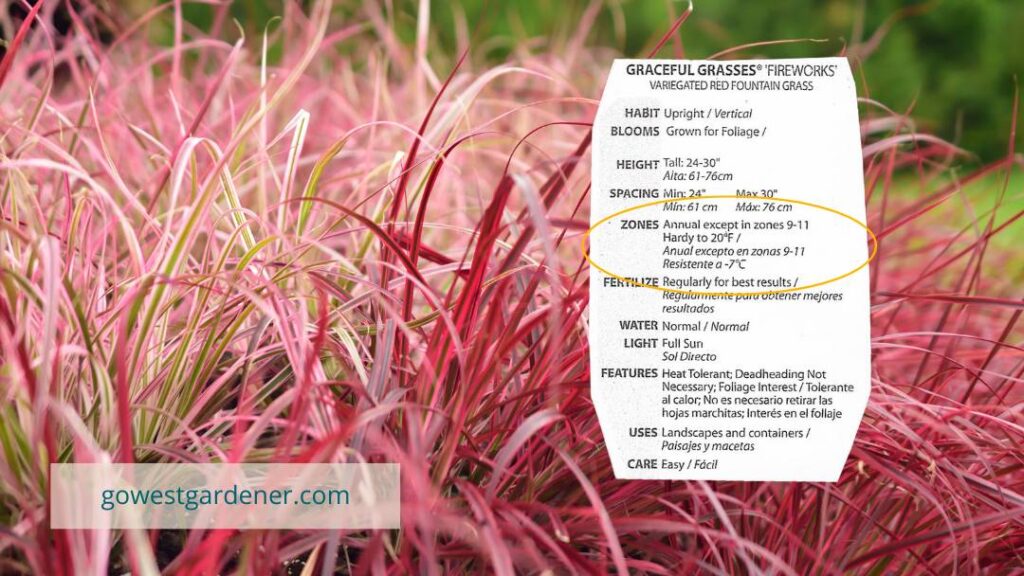
You see this red fountain grass (below) at the store, and you’d love to plant it in your garden. The plant tag says it’s “annual except in zones 9-11.”
This plant tag is telling you that this grass will likely only survive winter temperatures in Zones 9-11.
Because you are in Zone 5, this plant will look great in your garden for one summer, but it should NOT come back next year. It isn’t “cold hardy” where you live.
Let’s look at another example
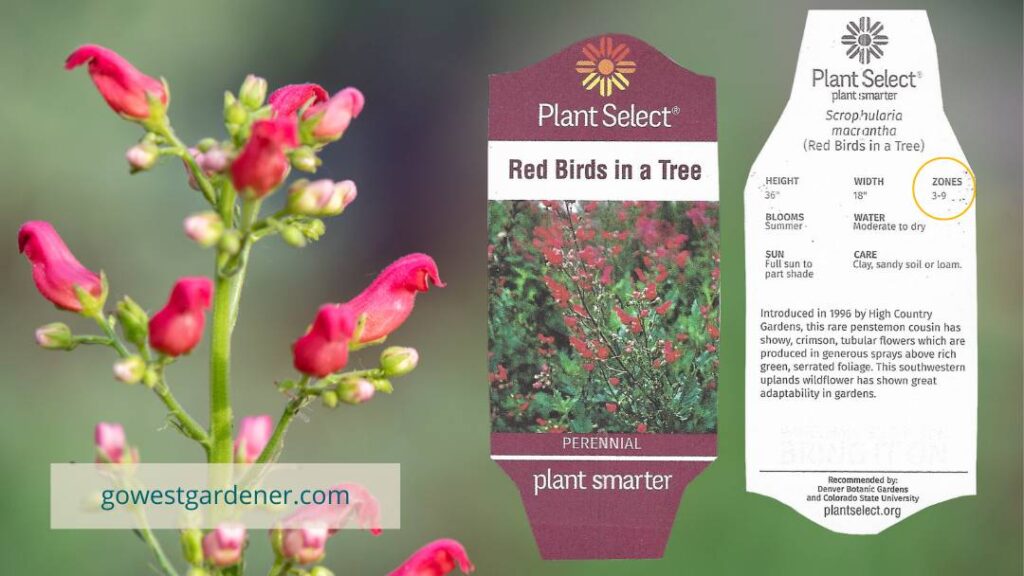
You like the look of the plant below called Red Birds in a Tree. (By the way, this is one of my favorite plants in my garden. My neighbors always ask about it, and the hummingbirds LOVE it!)
The plant tag for this flower says, “Zones 3-9.” Do you see the zones below?
In our example, your garden is in Zone 5, so this plant SHOULD return next year. It should come back in any of the Zones 3-9.
Use your zone to be a smarter plant shopper
When you buy plants that you want to return every year:
- Don’t assume that the plants at the store are right for where you live.
- Check the plant tags to make sure their plant hardiness zones match yours.
- If you’re buying plants online, look for each plant’s hardiness zone in the online description of the plant.
If you pick a plant that doesn’t match your zone, you may find yourself a replacing dead plant next year!
While your plant hardiness zone is helpful, it’s only ONE part of choosing the right flowers for your western garden
Remember that your plant hardiness zone is like your jean size.
When you’re buying jeans, the size is important, yes.
But you probably care about other things too — like the the length, fit and color.
If you’re 5’3′, tall jeans are going to create unnecessary work for you.
And we do not want unnecessary work!
In your western garden, you also want to know:
- How much water your plants need (can they tolerate semi-arid conditions and drought?)
- How well your plants can handle intense sunlight (at elevation, we’re closer to the sun, so our sunlight is tougher on plants)
- Your plants’ tolerance to things like hail and wind
- What kind of soil the plants like
- And more
Here’s an example of what can happen if you only think about your plant hardiness zone.
Again, let’s say you live in Zone 5.
If you ONLY consider your plant hardiness zone when choosing flowers, you may find yourself planting the same flowers that thrive in humid, rainy, coastal Maine.

Not the best idea for your semi-arid garden in Colorado or Utah, right?
It’s helpful to choose flower plants that fit your zone, but know that your zone is only one part of finding the best flowers for your western garden.
Related tips that may interest you:
by Ann at Go West Gardener | Updated: Jun 20, 2025 | Best Flowers for Colorado, Utah & Similar States, In-ground garden, Waterwise Gardening in the Intermountain West, Western Container Gardening With Flowers
This cutie is known as Lantana.
This colorful flower reminds me of a delicious bowl of sherbet.
It isn’t a flower you want to eat, though — no matter how yummy it looks.
It’s actually a little poisonous. Be careful where you plant it if you have wee ones or dogs.
The butterflies and hummingbirds love Lantana, though!
Lantana is an “annual” in western states like Colorado and Wyoming.
This means it blooms all summer, but it doesn’t return next year.
Add this flower to your flowerpots or in the ground for a BIG pop of color.
Here’s why to add this colorful beauty to your summer garden…
- Lantana can take the heat, so it’s a good flower to try in your garden hot spots.
- It’s easy going. Lantana grows well in sunny locations, as well as partly shady spots.
- You’ll find it in many colors, from vibrant oranges and electric pinks, to calming yellows and purples.
- It tolerates drought, which is good in our semi-arid climate.
- Lantana attracts butterflies and hummingbirds. Yay!
- This plant is deer resistant, so it isn’t the first choice of deer for munching.
Do you live in another region of the country?
If you live outside the Rocky Mountain region (like in the Southeast or Southwest), ask at your local garden center whether Lantana can be grown where you live.
There are some places where it isn’t allowed.
Related topics that may interest you:
by Ann at Go West Gardener | Updated: Mar 20, 2026 | Flower Garden Basics, In-ground garden
You’re at the store this spring, and colorful flowers catch your eye. It’s natural to want to drive straight home and plant them. Bring on the curb appeal!
But hold up…
Before you plant your flowers, it’s a good idea to help them adjust to outdoor conditions first.
In garden lingo bingo, this is known as “hardening off” or “acclimating” your plants. Many flower plants have been growing inside in greenhouses. They’ve had spa-like conditions indoors. And they’re all soft and tender from these comfy conditions.
Gradually exposing them to outdoor conditions helps toughen them up to wind, sunlight and outdoor temps. For example, their cell walls grow thicker. And they can better resist the stresses of being outside.
Think of this like preparing for the start of ski & snowboard season.
Sure, you could hit the slopes without getting your legs ready. But if you haven’t been working out, your legs are going to be ON FIRE after your first day out. You may be too sore to ski or ride for the rest of the week.
If you cross-train first, your muscles will be in much better shape. You’ll have more endurance.
Cross-training your flowers gives them more toughness too.
What happens if you don’t harden off your plants?
It can be a shock for young plants.
(And shock is not what we’re going for!)
Plants that haven’t been hardened off can struggle in multiple ways, says the University of Nebraska Extension. For example, these plants:
- Are vulnerable to sunburn, windburn (moisture loss and tissue death), and dehydration from freeze damage.
- Can break or shred easily.
- Can become stunted or die.
I see sunburn on a lot of newly-planted flowers around the Denver area in the late spring. It looks like their leaves have been bleached.
You’ve paid good money for your flowers. You want healthy plants—not flowers that look like they’re struggling, right?
Here’s how to gradually harden flowers to the outdoors:
Put your flowers outside in a protected spot for a few hours. What’s a protected spot? Look for someplace that doesn’t get direct sunlight and is sheltered from the wind, like a covered porch right up next to your home.
Then, bring them back inside or into an attached garage.
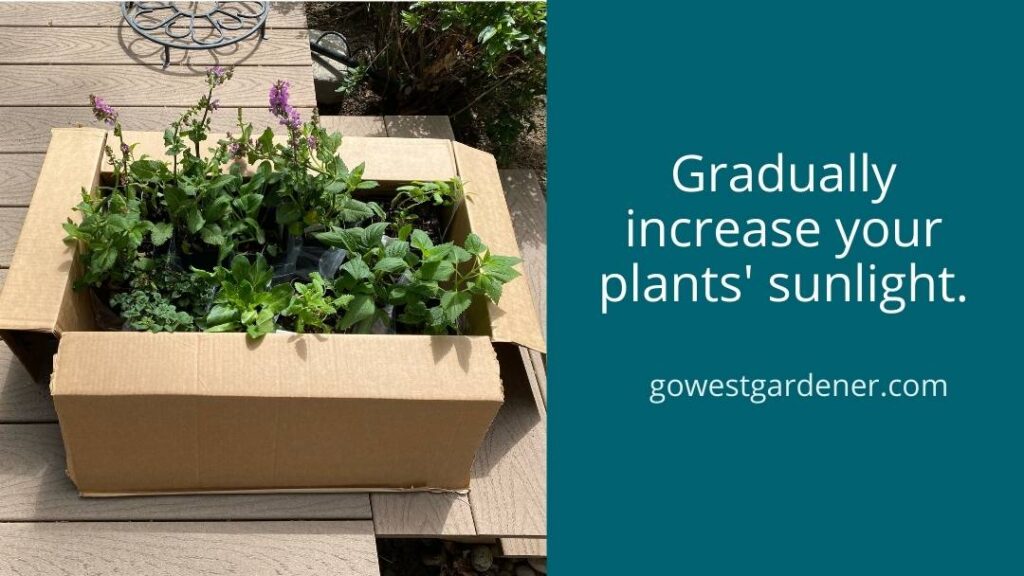
Give them a little more exposure to wind and sunlight each day. Add a few hours each day. You’ll build up their endurance, so they’re ready for planting. If your flowers like sunlight, start with shade… then morning sunlight… then work your way up to afternoon sunlight. Also work them up to staying outside overnight by the end of your hardening off period.
Try to keep your flowers from getting dried out and wilting. It’s easy for flowers to get dried out in their small nursery pots. If you pick them up and they feel light in your hand, they may need water. But if you see a few leaves turning yellow and they feel heavy when you pick them up, they may be getting too much water. Slowly reduce the amount of water you give them—but not so much that they look droopy.
Keep your eye on temperatures. If temperatures are dipping down near freezing, keep your plants inside.
Don’t fertilize them. Hold off on encouraging new growth.
Worth noting: Some flowers and veggies like warmer air and ground temperatures. They won’t do well if temps drop below 50-55 degrees. If you aren’t sure what your plants prefer, just ask at the garden center.
How many days should you harden off plants?
Some agriculture extension offices say 7-10 days. Others say 5-7 days. And some say 10-14 days.
I usually go about a week for the plants I’m buying from the store.
Ways to make it easy, peasy to harden flowers:
Make your plants easy to carry. Put your plants in a laundry basket, an open Amazon box or another container, so you can quickly move them inside and outside.
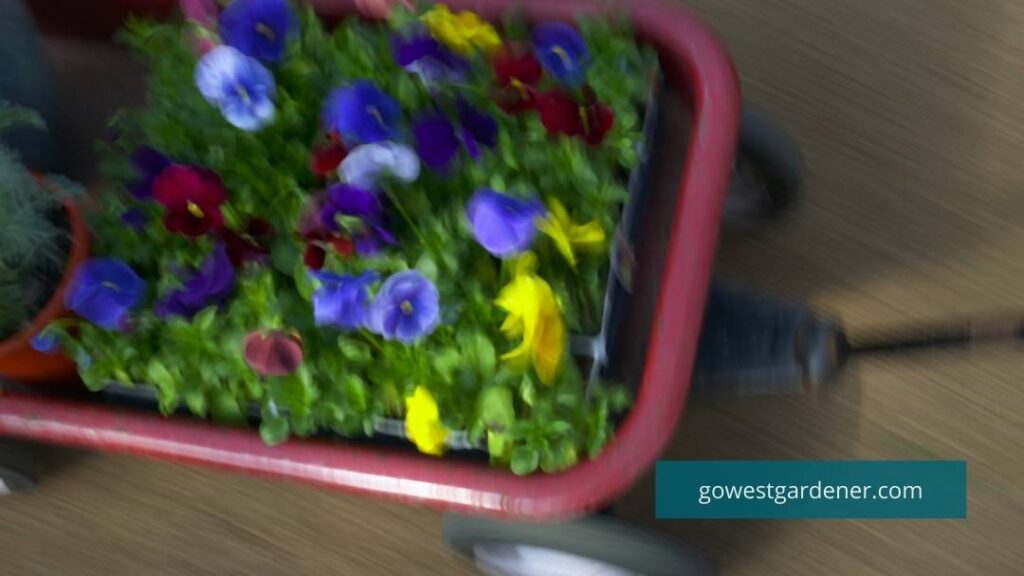
Roll, baby, roll. I have a neighbor who puts her plants on a small wagon that she wheels in and out of her garage each day.
Schedule reminders or set an alarm on your phone. That way, you’ll remember to take your flowers out. More importantly, you’ll remember to bring them back inside. (An alarm can be so helpful!)
Get creative if you head to a job every day. Maybe you want to start cross-training your flowers on the weekend. Then, if you’re going to leave them out all day during the week, start with protected spots.
What kinds of flower plants should you harden off?
- Flower plants that have been growing inside. This includes annuals (the one-season-only flowers) and perennials (the flowers that come back each year). Even some of our toughest plants in the intermountain west need to adjust to outdoor conditions. If you’re buying plants at an indoor nursery, it helps to harden them off. If you see plants outside at a store and you aren’t sure when they arrived from the greenhouse, I’d err on the side of hardening them off.
- Flowers you’re planting in the mountains. According to the Colorado State University (CSU) Extension, many mountain plants are grown in nurseries below 6000 feet. These plants may not be ready for mountain conditions yet, so it helps to harden off these plants. If your flower plants have been locally grown and they’re growing outside, they’re likely hardened off already.
- New seedlings you started inside your home and are transitioning to the outdoors. These plant babies are more likely to need more time to harden up. I’d give them 10-14 days.
If your flower plants have been growing outside already, you should be good.
Related topics that may interest you:
by Ann at Go West Gardener | Updated: Mar 20, 2026 | In-ground garden, Western Container Gardening With Flowers
Are you feeling adventurous this spring? Want to add a splash of color to your flowerpots?
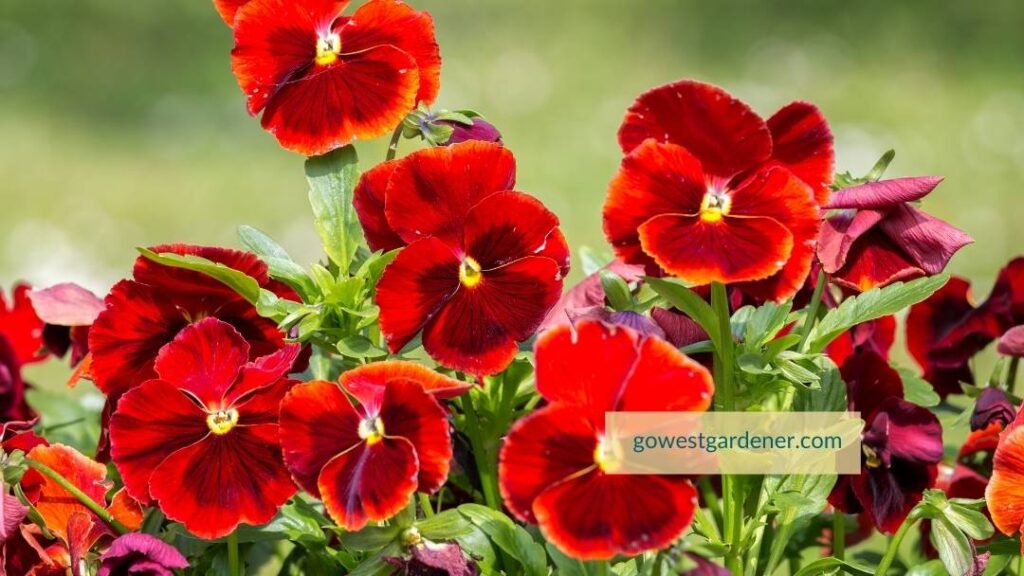
Get to know pansies — a type of viola! These early spring flowers can add a BIG pop of color to your Colorado garden, especially if you’re ready to kiss winter goodbye.
You may be thinking, “Wait, can I plant flowers in pots in March? It seems a little early.”
You can plant pansies in March, April and May in most of Colorado, even though we can still get snow and yo-yo temperature swings. (Weird, right?)
If you live someplace else in the West, your timing may vary just a little, but timing aside, all these tips apply.
Pansies can handle cool temperatures.
Pansies are in their happy place when temperatures are in the 40s to 60s, and they’re surprisingly tolerant of our wacky spring weather.
Typically, March and April are good times to start planting pansies at our lower elevations in Colorado.
In my garden in the Front Range, I find that late March is often an ideal time to plant pansies. We’re usually past all those arctic temps. (More on this below!)
If you live in the mountains, I may wait a bit longer, depending on how cold your temperatures are and how much snow you have.
What growing conditions do pansies like?
Pansies grow well in dirt (or “soil” in garden lingo) that drains well and is rich in nutrients.
Many of us don’t have rich, well-draining soils in the intermountain west. But no worries! You can plant your pansies in pots with a good potting soil.
Western states (like Colorado) get intense sunlight, so it helps to plant your pansies someplace that faces east, whether it’s a patio, front porch or garden. These spots get morning sunlight, which isn’t as hard on pansies as afternoon sunlight.
If you’re planting pansies in afternoon sunlight, you may want to find a spot that gets “dappled” light (sunlight through tree branches) or a little shade (like a western-facing porch that gets some cover).
Can you plant your pansies directly in a west-facing or south-facing spot?
Sure!
Just know that as soon as temperatures heat up, your pansies may start looking stressed. You’d likely get a little more mileage out of them in an east-facing garden.
What kind of care do pansies need?
Pansies benefit from “deadheading” (trimming off dead blooms) and fertilizing. This keeps them looking good.
Look for a mild flower fertilizer with a 5-10-5 ratio. Those are the numbers you’ll see on the container. This ratio helps support root growth and encourage new flower blooms.
What to do when you bring your pansies home
It’s tempting to plant your pansies right away.
You got them to enjoy them, right?
But chances are they’ve been growing in a cozy, warm greenhouse. They’ve been living large in spa-like conditions, and they’re tender. Gradually exposing them to outdoor conditions can help them toughen up. In garden lingo, this is known as “hardening” your plants.
Otherwise, they may struggle.
You can find out how to harden pansies here.
Pansies can handle cold temps, but they DO have their limits.
Pansies that are healthy and have been planted a while can usually handle quick dips into the teens and single digits.
But newly-planted pansies can be more sensitive.
After a warm, sunny day in Colorado in the early spring, it’s easy to forget how cold it can get at night, so watch those nighttime temps.
While newly-planted pansies can usually tolerate a light frost, it helps to protect them (keep them warm) if your temperatures are going to drop below freezing.
You can find 6 ways to protect your flowers from frosts and freezes here.
PRO TIP: Keep your eye on the temps BEFORE you plant your pansies. If the weather forecast shows multiple days when temperatures are going to dip well below freezing, just hold off on planting them until you get through that cold spell.
Pansies don’t like hot weather.
Let’s say you live someplace with blazing hot summers, like our lower elevations in Colorado and Utah.
When temperatures start to rise, it’s a good idea to replace your pansies with flowers that are happier in the heat. Think of this like changing out your wardrobe from your spring clothes to your summer clothes.
For example, when summer arrives, I replace the pansies in my western-facing flowerpots with flowers that can handle the hot afternoon sun.
Do you have to replace your pansies?
Nope … but they’ll probably stop blooming in the heat, and they may look stressed.
Translation: They won’t look very good!
Pansies are treated as “annuals” in states like Colorado.
This means you’ll enjoy them for one growing season, but it’s unlikely they’ll return next year.
Related topics that may interest you:
by Ann at Go West Gardener | Updated: Oct 20, 2025 | Gardening Tips and Tricks, In-ground garden
It was a winter week to make a gardener shudder.
In February 2021, an arctic blast covered the western United States like a frosty ice pack from the kitchen freezer. Where I live in Colorado, the high temperature for several days was a not-so-balmy zero degrees. The nightly lows danced between -15 and -20 degrees below zero.
(It may have gotten even colder where you live!)
In the spring, many of my “marginally hardy” perennials did not come back.
Ugh.
Marginally hardy perennials are your “iffy” plants.
They could come back after winter. They should come back if your winter is mild. But if you get tough winter conditions or extreme colds, they’ll die.
So, if you want to know, “How can you tell if a perennial is marginally hardy?”, read on.
You’ll find a helpful way to tell if a perennial is marginally cold hardy.
Use this tip to choose plants that are more likely to handle our western weather and return to your garden!
First, a disclaimer…
(Don’t you love when people lead with disclaimers?)
There are MANY factors that can affect whether perennials will survive winter and return to your western garden in the spring — things like moisture, drought, wind, root health, micro-climates in your landscape, etc.
But to keep this simple…
We’re going to focus on winter temperatures.
Every plant has a threshold for how cold it can get over the winter and still survive.
If it gets too cold, it will die.
Your marginally hardy perennials won’t come back if it gets too cold for them over the winter.
And this is where plant hardiness zones come into play!
If you’re new to plant hardiness zones, don’t worry. I’ve included a brief explanation below. Or, you can learn about zones here, including how to find your garden’s zone.
Here’s a quick way to think about it.
When you buy plants, you’ll see zone numbers on their plant tags.
These numbers are a guide to how cold (or warm) it can get in the winter without killing the plant.
Zone numbers are kind of like a thermometer:
- Plants with lower zone numbers can survive colder winters.
- Plants with higher zone numbers can survive warmer winters.
The flower pictured above, Red Birds in a Tree, can survive very cold winter temperatures (in chilly zone 3), up through warm winter temperatures (in balmy zone 9).
Let’s say you live in plant hardiness zone 5 — like much of the Front Range of Colorado.
You find a flower plant you want to buy.
The plant tag says it grows in zones 5-9. (Remember, lower zone numbers mean the plant can handle colder winters.)
You live in zone 5, and the lowest zone that’s suggested for this plant is zone 5.
This perennial is marginally cold hardy where you live.
It’s right on the edge of being able to survive the coldest winter temperatures that are expected in your area.
If you get a winter with extreme lows, this plant may not make it, especially if it’s newly planted.
You may be more successful growing this perennial if you wait until the spring to plant it. That way, it has the entire summer to get established in your garden.
The same is true if you find a plant that grows well in zones 6-9.
Again, we’re looking at that first number.
This plant doesn’t like winters as cold as the ones that are possible in your area.
This plant is only marginally hardy where you live. If temperatures get too cold over winter, it won’t come back.
Still with me?
Let’s continue our example and talk about:
How to identify hardy perennials (aka, “cold hardy perennials”)
Again, let’s say your garden is in plant hardiness zone 5.
You find a flower plant that grows well in zones 4-8 or zones 3-9, like Red Birds in a Tree below.
This plant is a cold hardy perennial where you live.
It can survive colder winter temperatures than you normally get.
Related tips that may interest you: