by Ann at Go West Gardener | Updated: Nov 17, 2023 | Garden design Ideas, Gardening Tips and Tricks, In-ground garden, Waterwise Gardening in the Intermountain West
Walk among the flowers and feel your stress lift away!
Visiting a local botanical garden is a wonderful way to relax in nature and find inspiration for your own garden. Many local botanical gardens feature beautiful flowers, shrubs and trees that grow well in our tricky, semi-arid climate.
Here are links to many public gardens in the intermountain west, so you can find a botanical garden near you.
Botanical gardens in Colorado
Colorado also has waterwise demonstration gardens and native plant gardens. These gardens can be good places to see examples of natives plants and drought-tolerant plants.
Here are a few demonstration gardens along the Front Range:
You may want to search for waterwise demonstration gardens in your area.

Botanical gardens in Utah
Botanical gardens in New Mexico
Botanical gardens in Idaho
Botanic gardens in Wyoming
Botanic gardens in Montana
If you don’t see your state listed above, simply search for phrases like:
- Botanic gardens near [your city or state]
- Best gardens in [your city or state]
The American Horticulture Society has a search feature on their website to help people find botanical gardens that welcome members from other gardens. I find their search tool useful if you want to find botanical gardens by state. They don’t list every garden, but they include a lot of them.
You also can search for “demonstration gardens” near [your city or state]. Often times, demonstration gardens are good places to get ideas for waterwise (drought-tolerant) plants for your garden.

by Ann at Go West Gardener | Updated: Mar 20, 2026 | Gardening for Pollinators, Gardening Tips and Tricks
Black-eyed Susan (officially, Rudbeckia — Rude-bek-ee-uh) is an easy-to-grow flower that can add big color to your western garden, particularly in the late summer.
But often, gardeners plant Black-Eyed Susan… and it doesn’t come back
If this happens to you, you may find yourself thinking: “Well, that article was a load of crap.” 🙂
Or worse, you may think: “I guess I just don’t have a green thumb.”
I’m here to tell you this isn’t the case! But there are helpful things to know about Black-Eyed Susan that don’t always get mentioned at the garden center.
So, in this article, you’re going to learn…
How to tell the difference between short-lived vs long-lived Black-Eyed Susans (“biennials” vs “perennials”)
I’m going to use a little garden lingo later in the article (bring on the Latin!), but I promise I’ll explain what it means.
Some types of Black-Eyed Susan are much shorter-lived than others.
So, what are some ways to know what you’re buying?
- Take a good look at the plant
- Look at the botanical name on your plant tag (the Latin jibber-jobber I’ll explain in a sec)
The plants below are Black Eyed Susan.
What do you notice?

In the Plant A photos, do you notice the hairy leaves and stems? When you touch them, they feel fuzzy.
If your Black-Eyed Susan is fuzzy, you likely have a shorter-lived plant
Fuzzy Black-Eyed Susan plants are known as Rubeckia hirta. They tend to be shorter-lived.
If you’re new to plant names: Rudbeckia describes a group of plants with similar traits. Hirta is like a descriptive adjective. It loosely translates to “hairy” or “rough” in Latin.
To keep things basic, plants with the botanical name, Rudbeckia hirta, include different types of hairy Black-Eyed Susan.
We’ll chat about WHY plants are hairy at another time. (Does this make your list of topics you NEVER thought you’d talk about today? “Hey, why are plants hairy?”) But for now, don’t let the hair distract you. The hair itself is not why the plant is shorter-lived. It just happens to be a clue you can use to assume you have a shorter-lived plant.
It also helps to look for the botanical name, Rudbeckia hirta, on the plant tag. Unfortunately, growers use ALL kinds of names on plant tags, so this isn’t always a sure thing.
The next question you may be wondering is,
“Okay, so how long do hairy Black-Eyed Susan plants live?”
Generally, Rudbeckia hirta are “biennials” or “short-lived perennials.”
They go through a 2- and sometimes 3-year life cycle, and then they’re done.
Depending on your garden center, you may find young, leafy Rudbeckia hirta in the “perennials” section of the store — the section with plants that come back.
But, Rudbeckia hirta can be sold in the “annuals” section of the store too. Annuals are the flowers that give you colorful flowers for one season, but typically don’t return next year.
(Because it’s never simple, oye!)
When the plant is in the annuals section, the garden center is likely selling it in its second of growth. Your plant is flowering, and it’s near the end of its life cycle.
You can just enjoy varieties like these for the summer and fall, and pull them out at the end of the growing season.
But if you have them in your flowerpots and you WANT to see if they’ll come back, you also can move them to the ground in the early fall to see if they’ll return next year.
Depending on where you live, these plants may survive a winter or spread through their seeds.
Even though Rudbeckia hirta plants tend to be short lived, they CAN make new plants from their seeds, so Black Eyed Susan may keep reappearing in your garden year after year.
Bonus! More plants!
(But reseeding is a topic for another day.)
Okay, back to our comparison photos.
What do you notice about Plant B?
Plant B has smooth stems and leaves.
It’s a different species of Black-Eyed Susan. Specifically, it’s the longer-lived type of Black-Eyed Susan known as Rudbeckia fulgida. Fulgida loosely translates to “shiny” or “glimmering.”
Think of it as a shiny-leafed Black-Eyed Susan.
Below, you’ll find some examples you may find at your garden center.
‘Goldsturm’ a is popular variety. It was the 1999 Perennial Plant of the Year — an award given to plants that are standouts from other varieties. This plant should return for many years.
‘Goldsturm’ is happier with moderate watering, so you may not want to plant it in a dry, hot garden.
Which Black-Eyed Susan is native?
A native plant is one that has existed naturally in an area for hundreds of years. It wasn’t introduced through European settlers.
Rudbeckia hirta — hairy Black-Eyed Susan — is native to the central United States. It is highly attractive to pollinators, and it’s a host plants for many butterflies (meaning they seek those plants out for their young).
So, if you’re interested in native plants for your garden and/or you want a pollinator-friendly garden, you may prefer growing Rudbeckia hirta.
Bring on the Black-Eyed Susan!
These aren’t the only species of Black-Eyed Susan, but they’re popular ones. And they’re a great place to start for your western garden.
The next time you’re at the garden center, look for Black-Eyed Susan plants. Touch the leaves and stems to see if they feel fuzzy.
If you feel hair, you’ll know what that clue is telling you: You likely have a shorter-lived plant.
Parting thoughts: This article is intended as an overview. It’s good to check the plant tag, or even better, read an online plant description from a grower for the specifics on the plant you’re buying, such as how long it should live, its plant hardiness zones, etc. There can be many nuances among individual plant varieties.
Related topics that may interest you:
by Ann at Go West Gardener | Updated: May 8, 2023 | In-ground garden, Western Container Gardening With Flowers
Looking for an easy-to-grow flower that gives you big, pretty color in the late summer?
I’d like to introduce you to Black-Eyed Susan (officially, Rudbeckia — Rude-bek-ee-uh). It also goes by the name: Gloriosa Daisy.
There are MANY reasons to love this flower.
In this article, we’re going to chat about why Black-Eyed Susan plants can be great flowers for late summer gardens in the West.

More than a month of colorful blooms? Yes, please!
If you’re new to Black-Eyed Susan, it’s a showy flower that resembles a daisy.
It often has gold or yellow petals and a black, brown or green center.
Typically, in states like Colorado, it will bloom in late July, August and even early September, so it gives you pretty color when a lot of other flowers are done blooming.
The exact bloom time depends on where you live.
Here are reasons to include these pretty flowers in your western garden:
- They’re bright and showy, adding a BIG pop of gold color to your garden in mid- to late-summer.
- They bloom for a looooong time. You may get up to 2 months of color.
- Some grow well in mountain gardens, as well as down at lower elevations.
- They tend to be adaptable to our tricky western soils, from clay soil, to sandier soils.
- They grow well in the sun, but some will tolerate places in your garden that get a mix of sunshine and shade.
- Some are drought tolerant once they’re established. (Ideally, though, many of them prefer moderate water. You may want to plant them near a downspout or in a low area that stays more moist.)
- They don’t like a lot of fuss. They’re usually happier without things like fertilizer.
- They tend to be deer-resistant, meaning these plants aren’t Bambi’s first choice for breakfast.
Translation: This is an easy-going, low maintenance plant for western states like Colorado and Utah.
And cheers for plants that aren’t a lot of work, am I right?
But here’s what doesn’t always get mentioned…
Some types of Black-Eyed Susan are shorter-lived than others.
I share this with you because if your plant doesn’t come back, you may think you did something wrong.
But nope, you may have just purchased a shorter-lived Black-Eyed Susan! Find out how to tell them apart here.
Related topics that may interest you:
by Ann at Go West Gardener | Updated: May 8, 2023 | Gardening Tips and Tricks
Trimming off the dead blooms from your flowers can make them look even prettier.
It’s like giving them a fresh, new haircut!
But when you remove the dead blooms, should you pluck them by hand or with a tool?
I got this question and wanted to chat about it here.
For many flowers, using your fingers to remove the dead blooms is fine.
Once you get the hang of trimming off the dead blooms on your flowers (known as “deadheading”), you’ll be casually passing by your flowerpot with a cup of coffee in hand, and those dried-up flowers will be calling to you.
It’s hard to resist the urge to stop and pinch them off with your fingers.
Tip: It helps if you have longer fingernails, and you aren’t wearing gloves.
But, as I’ve learned the hard way…
Pinching off dead flowers with your fingers has its drawbacks.
- You may accidentally break off parts of the plant you didn’t intend to. And for me, it always seems to be a really pretty flower that’s about to open or a whole stem with new buds. (Ack!!!)
- It’s hard to be 100% accurate where you’re pinching a plant with your fingers. The stems don’t always break off cleanly or where you wanted. You can end up with some cuts that aren’t great for the plant and leave dead, stick-like stems. Not exactly the look we’re going for!
- Your hands can get sticky, depending on the plant. (I’m looking at you, petunias.)
- Some flower stems are just too thick to pinch with your fingers.
So, instead, consider using floral snips or hand pruners.
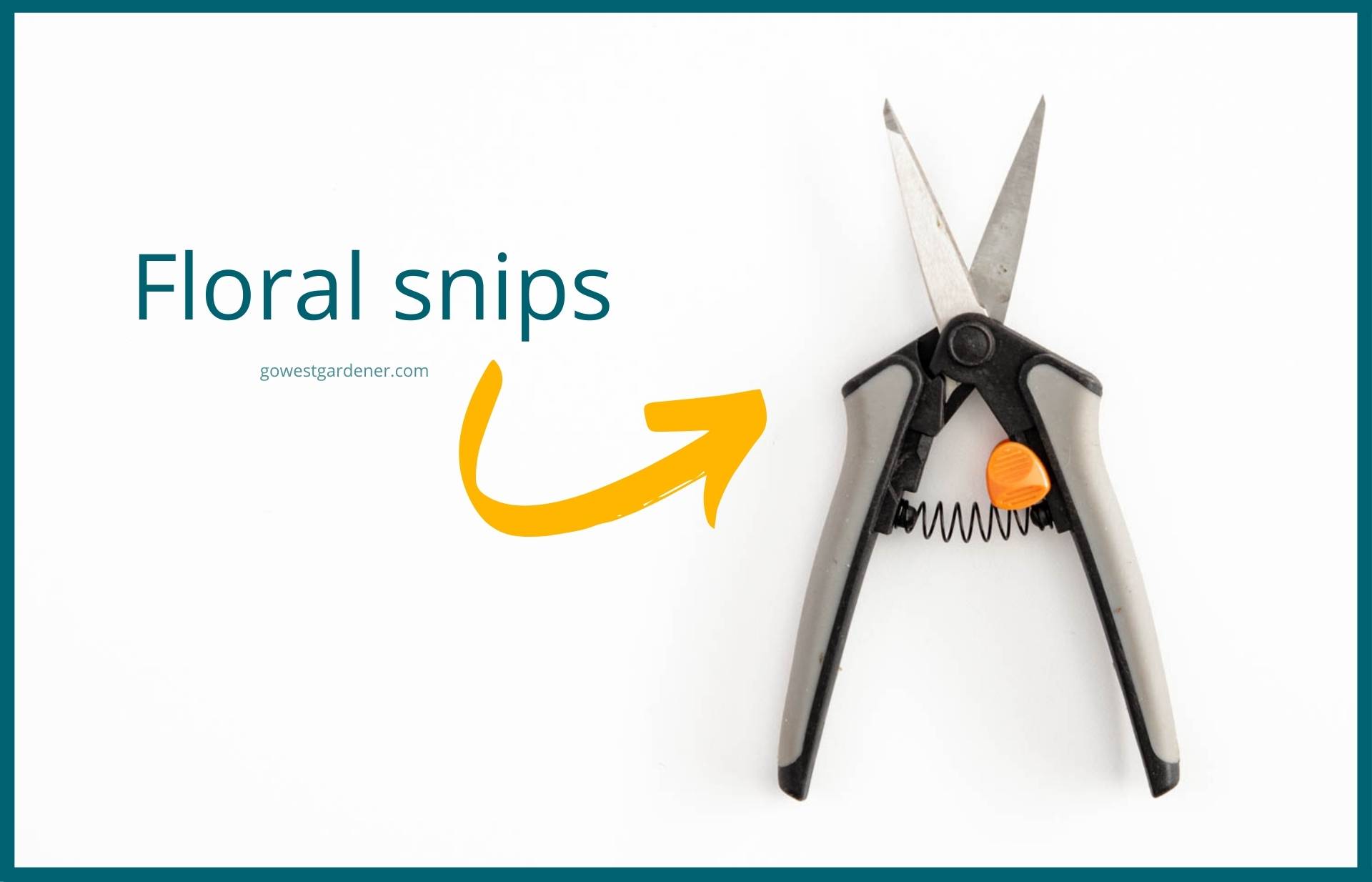
I use floral snips most of the time.

Floral snips are a small pair of scissors for trimming plants.
Tip! I leave my floral snips in an inconspicuous spot outside my door, so I can quickly pick them up when I walk outside. This helps me resist the urge to trim dead blooms with my fingers.
It also helps me trim dead blooms as I see them, rather than waiting until the plant is full of them.
(Translation: Keep those colorful blooms going!)
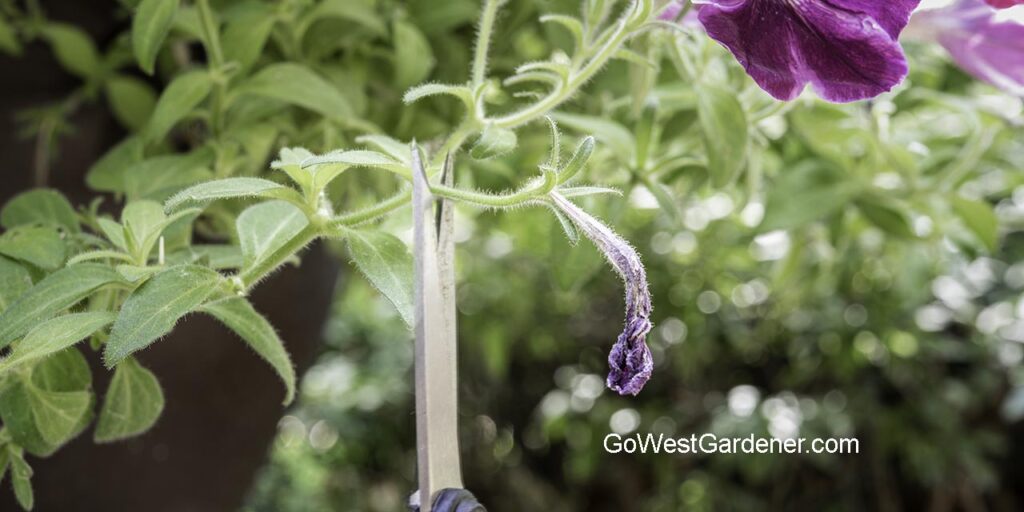
Floral snips are awesome because you can be VERY accurate in where you’re making a snip.
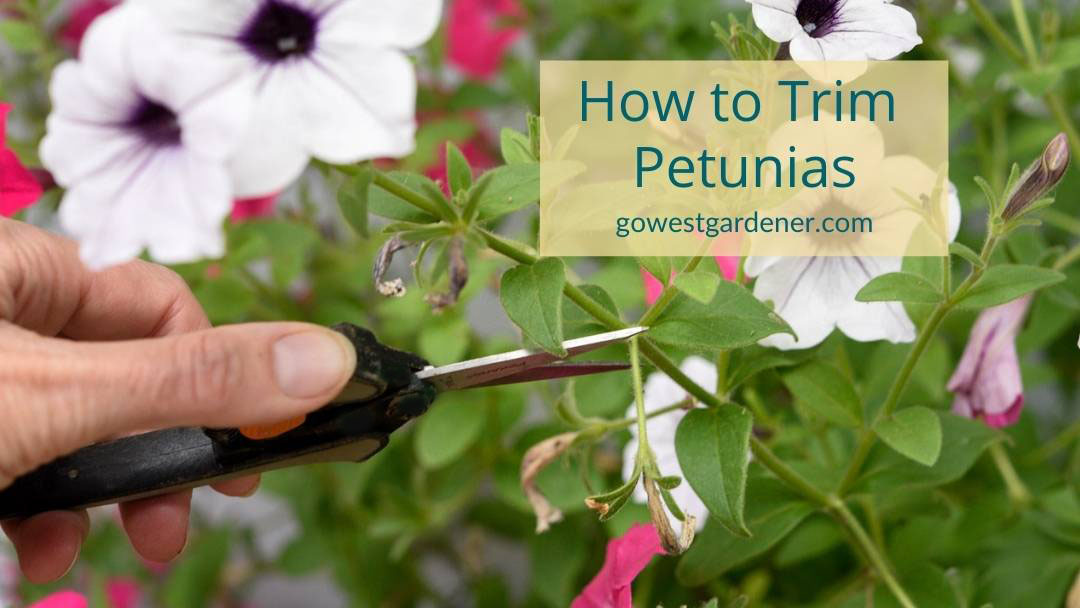
In the photo below, check out the precision you have when trimming off a petunia bloom.

Plus, if you want, you can wear gloves to keep your hands clean.
Floral snips work really well on flowers with thin stems, which are probably most of the flowers in your containers and many of the flowers in your garden.
But learn from my mistakes!
Don’t use your floral snips to cut thick-stalked plants.
You can accidentally squeeze the plant stems (not good) and really dull your snips.
Also, this may go without saying, but keep your floral snips for trimming plants.
My husband likes to borrow my floral snips for impromptu sprinkler projects, like cutting lines of tubing. The snips are never the same afterwards.
Moral of the story:
Hide the floral snips from your industrious Honey. 🙂
If you’re cutting a thicker-stemmed plant like a rose stem or a “cut flower”…
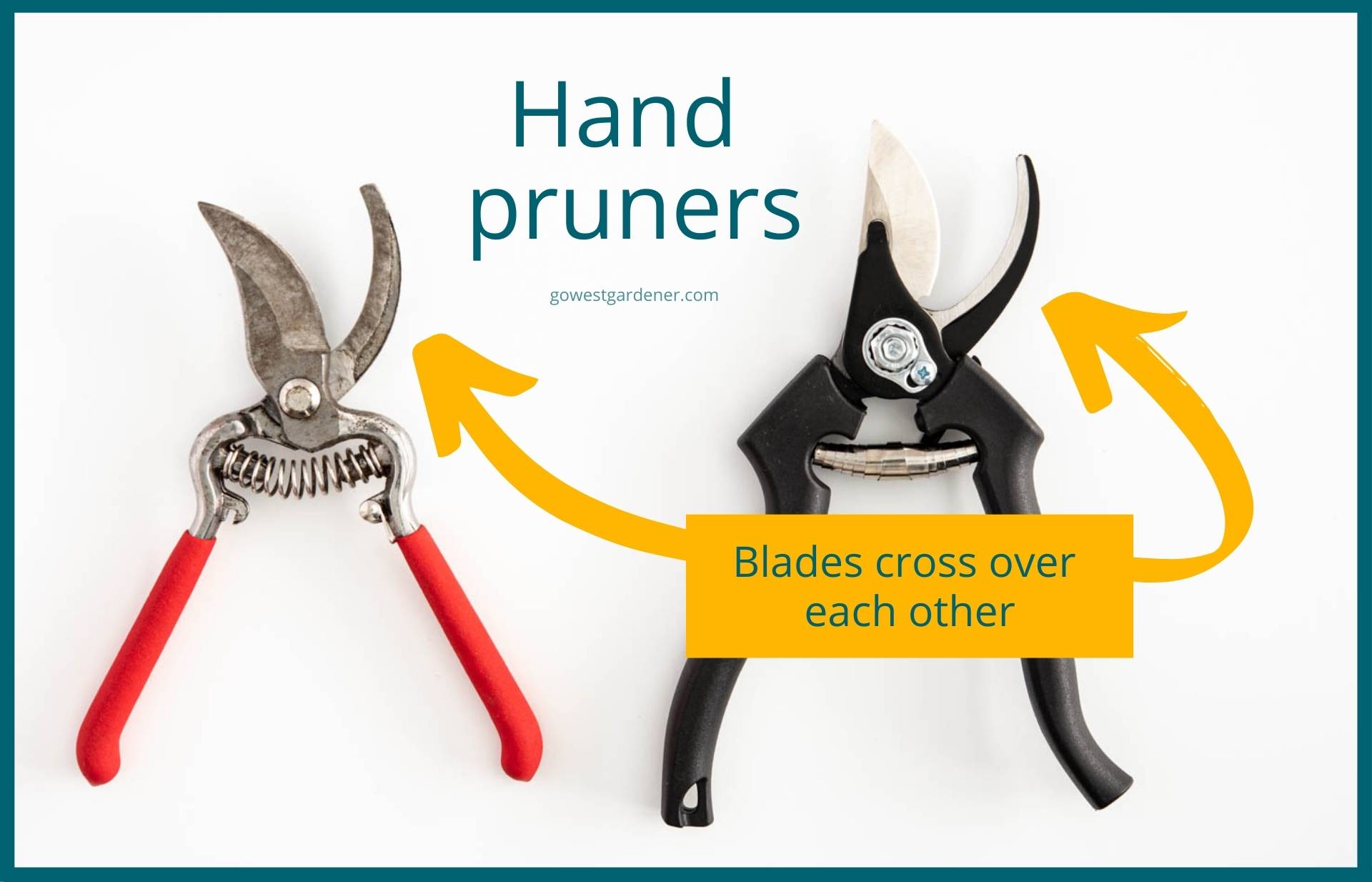
I suggest using hand pruners.
Hand pruners are a sturdier and bigger tool.
“Cut flowers” are the flowers you see in bouquets. Often times, they have thicker stems.
When choosing hand pruners, make sure the metal blades cross beside each other, rather than meeting at a center point.
This gives them extra strength for cutting.
It also ensures you won’t break or squeeze your flower stalks.
Where to find floral snips & hand pruners (new or used)
You can find new floral snips and hand pruners at your local garden center.
In the spring and early summer, you’ll often see them at places like Costco too.
If you prefer used garden tools, check out estate sales or websites like NextDoor, Craig’s List or OfferUp.
When you get used garden tools, clean them with soap and water and a disinfectant when you bring them home. This will help you lower the risk of spreading weeds or diseases to your plants.
I like the Fiskars brand for floral snips and hand pruners.
I’m not an affiliate for them. I’m just sharing their name for your convenience.
Related topics that may interest you:

by Ann at Go West Gardener | Updated: Sep 16, 2025 | Gardening Tips and Tricks, Western Container Gardening With Flowers
You want to “clean” your petunias, so they look pretty and tidy.
But how do you know you’re trimming off the right parts? What’s a new bud versus a dying flower?
In this short video on petunia care, you’ll see get simple tips and clear photos on:
- EXACTLY what to look for on your petunia plants, so you don’t cut off the wrong parts
- The key differences between dying flowers and new buds
- What a seed pod looks like (and why you want to remove it)
And if you have flowers that look like mini-petunias — which you may know as Million Bells, Super Bells or Calibrachoa — this video can help you too.
Click above to watch.
Prefer to read?
Simply scroll down for the transcript.
TRANSCRIPT:
How to Care for Petunias, So You Aren’t Trimming Off the Wrong Parts
How do you tell the difference between a new bud and a dying flower on your petunias?
It’s not always easy to tell.
That’s what we’re going to talk about in today’s tip.
[music]
Hi, I’m Ann with Go West Gardener.
Inspiring new western gardeners to find their green thumbs with flowers.
It’s awesome that you want to clean your petunias, so they can grow new flowers for you.
But, at the same time, you want to make sure you aren’t cutting off new blooms by mistake!
First, if you are ever unsure whether you’re looking at a bud or a dead flower, I say, give it a couple of days.
Because within a few days, it should become more clear.
If the bloom is dying, the petals will look more dry and even more shriveled up.
And if they’re new buds, they’ll look even bigger, and they should have more color to them.
You’re going to see some changes.
But let’s say you want to know now.
Here are some ways to tell.
It helps to think about a petunia bloom as a torch and a flame.
The little stem is the torch and the petal is the flame.
One of the easiest ways to tell if the flower is ready to be trimmed is you will have a shriveled up flame sitting on a torch.
The petals, which we’re calling the flame, will be curved over.
They’ll often change color, getting really dark or brown or gray.
And they’ll almost feel like shriveled up paper.
Another thing you may see is just the torch.
The petals have fallen off on their own.
The torch doesn’t have any additional leaves on it.
It’s often pretty long, and it connects at the stem.
Even if the flame is gone, it helps to trim off this torch because if you don’t, the torch may begin forming a little green kernel in the middle.
This is a seed pod, and it means your flower is turning its attention away from making flowers.
And we want flowers!
Let’s look at another example.
Can you see the torches on this petunia that are ready to be trimmed?
There’s this one here.
It’s the most obvious because it has a shriveled up flame.
But you’ll also see a torch here.
Here.
Here.
And here.
These are all ready to be trimmed off the plant.
If you haven’t been trimming off the torches, the first time you clean up your petunias, you may find yourself cutting off a lot of them at one time.
It helps to trim them off as you see them.
This will help keep your petunias’ energy focused on making new flower buds, rather than going to seed.
But let’s go back to our example for a second.
There are also new buds on this stem.
Here.
And here.
What are some clues that they’re new?
You’ll often see leaves on them.
The torch is just opening up.
And often times, the torch stem is still really short in length.
Okay, so let’s talk for a second about the in-between phase when the petunia flame is either getting ready to bloom or it’s dying.
To tell if it’s a new petunia flower, there’s a lot of structure to it.
You’ll see the bud is pretty firm.
I like to think of it as being architectural.
It kind of looks like a drill bit.
You’ll see a clear structure to it at the top of the bud.
And the flower opens in a distinctive pattern.
In contrast, though, a fading bud – that’s one that’s dying – doesn’t have as much shape to it.
It’s soft, kind of a blob, and it’s starting to shrivel.
Can you see the difference?
If you’d like more ways to feel more confident with gardening in the West, please click to subscribe to this channel [on YouTube].
See you next time.
[music]
Related topics that may interest you:
by Ann at Go West Gardener | Updated: Jun 20, 2025 | Gardening Tips and Tricks, Western Container Gardening With Flowers
If you have petunias, you may be wondering how to keep your petunias looking good, especially when the blooms start dying.
In this week’s video, you’ll:
- See exactly where to trim your petunias, so your plants look pretty and you encourage them to keep giving you new blooms.
- Find out when you DON’T need to prune your petunia plants.
- Discover what to look for to make sure your petunias aren’t “going to seed.” When your petunias start making seeds, it takes a lot of their energy.
Click the video above to watch.
Prefer to read?
Simply scroll down for the transcript.
TRANSCRIPT:
How to Trim Petunias to Keep Them Looking Pretty
Are you wondering, “How do I maintain my petunias?”
“When the petals die, what am I supposed to do?”
That’s what we’re going to talk about in today’s tip.
Hi, I’m Ann with Go West Gardener.
[music]
Inspiring new western gardeners to find their green thumbs with flowers.
I love that you’re wondering how to maintain your petunias because taking a few small steps can make a big difference between colorful, showy flowers versus having stringy, kind-of-boring looking petunias.
Let’s dig in.
Petunias can go through a cycle of blooms.
They flower, that flower bloom dies, and then new flower blooms show up on your plant.
On many petunias, though, you need to manually remove the dead blooms in order to encourage new ones.
This is known as deadheading.
And yes, it’s more than just picking off the dead petals.
Here’s what I mean.Think of your petunia bloom as a torch holding a flame.
This little stem is the torch, and your petal is the flame.
So, when petal dies, people often do one of two things.
One, they remove the dead petal (the flame), but they leave the little stem (the torch).
Or two, they may just wait for the dead petal to fall off.
Here’s the problem.
You may create a little seed pod where the flower was.
It looks like a green kernel.
Do you see it here? It grows in the center of the torch.
This is known as “going to seed.”
And while going to seed sound like a great thing, it means your plant could stop giving you new flowers.
And we want colorful blooms.
So, here’s what you want to do instead.
You want to cut off the entire torch, trimming back to the nearest main stem.
Right here.
Now, some petunias have been bred, so that they can’t go to seed or they mostly deadhead themselves.
Like the “tidal wave” variety.
You’ll see this name on the plant tag when you buy it.
In theory, this means you don’t have to remove the dead blooms.
When you look at the little torch, you SHOULD see a brown center.
But if you see a green center, Mother Nature has found a way to go to seed, and you may want to trim off that torch down to the stem.
Please click subscribe below [on YouTube] … and share a little love while you’re at it.
See you next time!
[music]
Related topics that may interest you:
by Ann at Go West Gardener | Updated: Mar 7, 2025 | Flower Garden Basics, In-ground garden, Western Container Gardening With Flowers
As you start to learn more about gardening, you’ll likely find yourself playing a game of, “garden lingo bingo.”
And you will definitely see the garden terms, “annual” and perennial,” somewhere on your bingo card.
In this week’s tip, you’ll get the scoop on:
- What’s an annual vs a perennial
- A helpful trick so you can EASILY remember which is which
- Important differences between annuals vs perennials — and why those differences matter for your western garden
- Garden center tips so you can know how annuals and perennials are typically arranged at the store
What’s an annual vs a perennial?
If you find the word “annual” confusing, you are NOT alone!
In my opinion, the word “annual” is one of the most confusing gardening terms because of how we use “annual” in casual conversation:
“Hey, we’re hosting our annual summer barbecue. Come on over!
In day-to-day conversation, we use it to mean, “recurring.”
But that’s not what annual means in gardening. Here’s how gardeners think about it:
An annual flower plant grows for one season.
Then it’s done.
One and done.
Technically, a true annual flower goes through its entire life cycle within one year (from seed, to baby plant, to flowering, to end of life).
But gardeners are practical people.
They use the word, “annual,” to describe any plants that only last one year where you live. This includes flowers that could come back next year in some parts of the country, but these plants can’t survive our winters.
To keep it simple, just remember it all comes back to:
One and done.
In contrast, a perennial flower plant comes back year after year.
Some perennials live a LONG time.
My mom has perennials growing in her back yard that are more than 45 years old! I have perennials in my Colorado garden that have returned for 15+ years.
Other perennials have shorter lifespans of about 3-5 years. For example, many Penstemon plants (pictured below) tend to be shorter lived perennials in the West.
Here’s an easy trick to remember annuals vs perennials.
Annual = A single year.
Perennial = Plenty of years to come.
So, let’s chat about key differences between annuals vs perennials… and why they matter for your western flower garden.
Keep in mind that Mama Nature makes her own rules, so there are always exceptions. 🙂
How long until your annuals and perennials are full size

Annuals grow quickly, typically reaching their full size in one season.
Perennials, on the other hand, can take up to 3 years to reach their full size.
When you buy your cute, little perennial at the store, remember that it’s likely going to grow taller and wider. Look at the plant tags (tucked in the containers) to see how big your flowers will grow and how much room they’ll need when they’re full size. This can help you avoid planting your flowers too close together.
When you first plant your perennials, your garden may not look as lush and full as your neighbors’ gardens.
Don’t worry! This is normal. You haven’t done anything wrong.
Your garden will grow. It just may take a few years. While your plants are growing, you can tuck flowerpots of annuals into your garden for more color.
What to expect from the blooms of annuals vs perennials
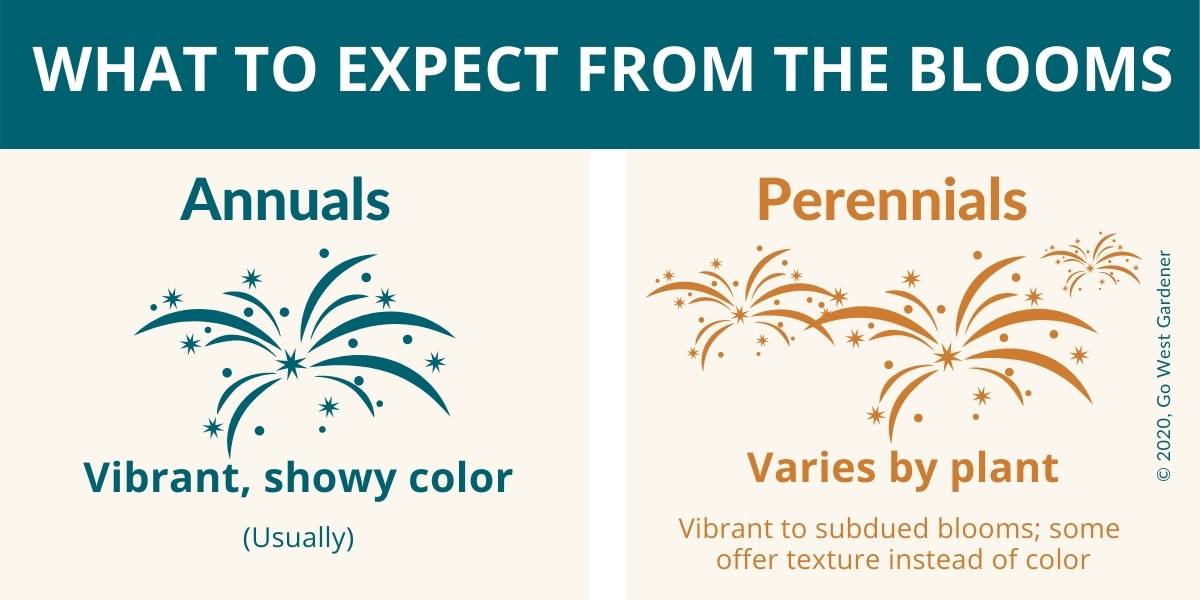
Annuals often give you big, showy color that goes on for a long time.
Typically, though, they don’t keep the same flower blooms for the entire summer. Instead, annuals push up flower blooms, those blooms die, and then new blooms come in. To help this process along, you may need to remove the blooms that have died. (In gardening lingo, this is known as “deadheading.”)
Perennials vary in how much color they give you. Most bloom for a much shorter amount of time, often just a few weeks. When temperatures are hot, flower blooms don’t last as long.
Where you grow annuals and perennials (typically)
You can grow annuals in containers, window boxes and in the ground.
In Colorado, we often get hail during the summer, so I prefer to grow annuals in containers, rather than in the ground. Annuals often need more water than the waterwise plants in my garden. Plus, I find it’s easier to move and protect my flowerpots when hailstorms are in the forecast.
Perennials are typically grown in the ground.
But can you grow perennials in containers? Yes, absolutely!
Just keep in mind that they’ll likely bloom for a shorter amount of time. Perennials also are less likely to come back next year if they aren’t planted in the ground. (Near the end of the growing season, it helps to take them out of your containers and plant them in the ground.)
Watering needs for your annuals vs perennials
Many annuals need quite a bit of water. (There are exceptions.)
Perennials, on the other hand, vary in their watering needs.
If you’ve moved to a western state like Colorado or Utah from another part of the country, you may discover that the perennials you planted elsewhere need A LOT more water here.
Rather than trying to plant flowers from other regions, a different option is to look for perennials that have adapted to our semi-arid growing conditions in the West. These “waterwise” perennials often thrive with very little watering once they’re established.
Read: Less work for you + happy plants!
How to find annuals vs perennials at your garden center
Many local garden centers will arrange annuals together and perennials together to help you keep them straight.
If you walk into a garden center and it feels overwhelming at first, you’ve got this! Remember that you can head for the annual section or the perennial section.
And if you notice one section of the garden center is WAAAAAY more colorful than others (like in the photo below), that is probably the annual section. Annuals give you big, showy color.
Sometimes, there aren’t signs, but people are happy to point you in the right direction.
So, don’t hesitate to ask!
(If you’re buying flowers at home improvement stores, they’re more likely to mix annuals and perennials together.)
Related tips that may interest you:
by Ann at Go West Gardener | Updated: May 8, 2023 | Flower Garden Basics, Gardening Tips and Tricks, Western Container Gardening With Flowers
Buying flower plants at your local home improvement store is definitely convenient. But did you know you have other options on where to buy flowers for your garden in western states like Colorado, Utah and Wyoming?
Let’s say you’d like to find unusual flowers in additional colors …
Or more options for flowers that thrive in our tough climate (yes, please!) …
Or more plants that have been locally grown …
If yes, there are OTHER garden stores where you can buy flowers, including:
- Locally-owned garden centers. They specialize in plants for your home and garden. (Think of this like going to a dedicated wine shop to buy a bottle of wine.)
- Online retailers where you can order hard-to-find plants. They’re like Zappos for flowers.
In this article, you’ll get a high-level look at the pros and cons of different types of garden stores, so you can choose where to buy flowers for your garden in Colorado, Utah and similar western states.

Let’s take a closer look at your options.
Home improvement stores
(A normal starting point)
Plant selection:
- Your plant choices are limited … but if picking flowers feels overwhelming, a limited selection can be a good thing!
Types of flowers available for your garden:
- You’ll find common, popular flowers.
- Different flowers bloom at different times of the season. So, the store’s plant selection will change over the spring, summer and fall, depending on what’s flowering at that time.
Knowledge of staff:
- Hit or miss …
- Sometimes, you’ll find really helpful and knowledgeable employees. Other times, you may find employees “who normally don’t work in this department.”
- It depends on your store and who is working at the time.
Pricing:
- You can find inexpensive prices.
Guarantee:
- Some stores offer a one-year guarantee on perennials.
- If the plant dies in the first year, they’ll replace or refund it as long as you have the original receipt.
Pro tip: Ask if your store offers a guarantee on perennials. If they do, put your receipt someplace where you’ll remember it.
How to be a smarter shopper at home improvement stores:
(1) Be aware that some flowers and shrubs you’ll find are not an ideal fit for our semi-arid climate.
Some plants are a better fit for regions of the country that get more precipitation. This means you’ll need to give them a lot of water here.
Others just don’t do well in our soil conditions.
In the photo below, you’ll see an Endless Summer Hydrangea. My local home improvement store sells them every summer, and they are GORGEOUS in the store … but generally, they don’t thrive in Colorado gardens. It’s tough to recreate their blooms every year. They need a lot of water. And they need very acidic soil to give you blue flowers. (We have alkaline soil in the West, so their flowers are pink.)
(2) Watch out for plants that have grown too big for their containers.
Roots are growing at the same time that plants are growing, so the containers need to be big enough for that root growth.
Sometimes, plants outgrow the size of their containers. This means the roots have gotten too big for the pots.
When you remove the pot, you may see the roots are tightly circling the plant. This is known as “root girdling.” You’ll need to take extra steps to fix it (read: extra work), so your plant doesn’t strangle itself.
Pro tip: As a general rule, the size of the plant should be about equal to the size of the container. You may want to skip a plant if the pot looks small compared to the plant OR you see A LOT of roots coming out of the bottom of the container. You could be buying a problem.
In the photo below, you’ll see an example of a plant with a lot of roots growing out of the container. (Big red flag!) The roots were a matted mess. It also looked like the roots had been trimmed off. This plant was likely in this container for a long time. It would have been happier if it had been transplanted to a larger pot. Roots need room to grow. I decided to skip buying this plant.
(3) Sometimes, annuals and perennials are mixed together at these stores.
Annuals are the flowers that give you big, showy color for one summer, but they don’t return next year. Perennials are flowers that return year after year, but they normally bloom for a few weeks only.
If you’re unsure whether a plant will return next year or not, you may want to ask.
Local garden centers
(aka, “plant nurseries”)
Plant selection:
- You’ll find a good-to-extensive selection of flowers.
- This can be great for finding more “wow”-worthy flowers, but it also can feel a little intimidating on your first visit. (This feeling is 100% normal, by the way. It will go away as you build some momentum with gardening!)
Types of flowers available for your garden:
- You’ll find a wider range of flowers.
- You’re also likely to find seeds, bulbs, vegetable plants, indoor plants, shrubs, and/or trees.
- The flower selection will likely change over the spring, summer and fall, depending on what’s flowering (“in bloom”) at that time.
- Often times, many of these plants have been grown at local or regional greenhouses and farms. This means these plants may adjust better to our western growing conditions when you plant them.
Knowledge of staff:
- Knowledgeable (typically).
- Because these stores are specialized, there are usually employees on-site who can answer your questions.
Pricing:
- Their plants can be a little bit pricier, but not always.
- Keep in mind, quality and price can be related. These plants may be grown in better soil and have fewer issues with girdled roots.
- They may offer sales or special offers. (“Buy three, quart-size plants for just $x.”)
Guarantee:
- Some offer a guarantee on certain types of plants. Some don’t. It varies widely by garden center.
- If the store doesn’t mention it, it doesn’t hurt to ask!
- It also helps to save your receipt.
How to be a smarter shopper at local garden centers:
- Watch for plants that are too big for their pots: While this isn’t quite as common at local garden centers, it’s still important to be on the lookout for perennials that have a lot of roots growing out of the bottom of the pot or plants that seem much bigger than their containers. Remember, you may be buying a problem.
- Some flowers you’ll find don’t necessarily do well in Colorado and the West. As I mentioned above, some plants may need A LOT of water here. But this really depends on the garden center you’re visiting. Some stores are better than others in carrying western-friendly plants.
How to find local garden centers in your area:
- To find locally-owned garden centers, search for “garden centers,” “plant nurseries” or “plant stores” in [your city/town] on the Internet. These phrases may pull up some home improvement stores too. It depends on where you live.
- Here’s a list of local garden centers by city that carry Plant Select flowers. Plant Select is a western-friendly brand of flowers plants and shrubs created by Colorado State University, the Denver Botanic Gardens and local horticulturists. It’s a great brand for western states like Colorado, Wyoming and Utah because these plants tend to grow well in our western conditions, are hail resistant and are less work. (Can I get an amen?!) The Plant Select website lists where to buy these flowers. I’m just sharing this brand for your convenience.I do not make a commission.

Online retailers
(They’re like Zappos for flowers)
Plant selection:
- You’ll find unusual flowers and exclusive plants that are often hard to find elsewhere.
- Typically, they have a finite supply, so once they sell out of a plant, it’s gone for the season.
Types of flowers available for your garden:
- These stores often have a specialty, such as perennials, bulbs (like tulips), cut flowers (the flowers you see in wedding bouquets or centerpieces) and/or seeds.
Knowledge of staff:
- Knowledgeable (available by phone or email).
Pricing:
- It varies, but be sure to factor in shipping costs.
- They may offer sales and special offers (like free shipping) from time to time.
Guarantee:
- Some may offer a first-year guarantee if you follow their planting guidelines. They’ll replace or refund the plant if it doesn’t survive.
- If you’re interested in a guarantee, always ask whether the online store offers it.
How you buy flowers at these stores. It’s DIFFERENT than buying local:
- You indicate the type of plant you want from a website or print catalog.
- The individual plant is picked out for you.
- The plant is mailed to you — often on a schedule, such as a certain week of the growing season.
- The plant may be small to make it easier to ship.
- If your plant isn’t available, the company may substitute a different plant. (They’ll likely notify you first.)
How to be a smarter shopper online:
- Look for mail order companies that specialize in flower plants for the semi-arid West — like High Country Gardens based in Santa Fe, New Mexico. (I am not an affiliate for this company. I’m simply sharing it for your convenience.)
- If you are ordering plants from a company that’s based in another region of the country, keep in mind:
(1) Flower plants that thrive in the East, Midwest, South, Pacific Northwest and along the West Coast may not do as well in our high elevation, semi-arid, inter-mountain West.
(2) You likely need to read between the lines on flower descriptions because the descriptions may be written with the East Coast (and their climate) in mind. For example, their sun conditions are different than ours. The sun is more intense at our elevation than in other parts of the country. 6 hours of afternoon sun in Colorado can be like full day of sunlight in other regions. Other parts of the country also get more annual precipitation than we do, so we may have a different definition of what it means for a plant to be “drought tolerant.”
- Know that plants can get a little beat up in transit. See the photo below for an example of a flower plant I received from an online retailer. The before image shows how the plant arrived. The after shows what the plant looked like after I removed the broken pieces. (This plant grew like crazy and was thriving by mid-summer, so don’t let the first impression scare you.) As long as the roots are okay and you follow the planting instructions that come with your plant, your plant should be okay. Good roots are firm. They look white or creamy in color. (Poor roots are soft, mushy and brown.) If you ever have concerns, you can reach out to the online retailer’s customer support team.
How to find online retailers:
Yes, there are other places where you can buy flowers for gardens
… ranging from your local grocery store to Costco.
But if you’re just getting the hang of gardening in Colorado, you want to know where to buy flowers that last, AND you want to keep it SIMPLE, these are good options to get started.
Related tips that may interest you:
by Ann at Go West Gardener | Updated: Jan 28, 2026 | Gardening Tips and Tricks, Western Container Gardening With Flowers
So, you walk into your local garden center …
You’re all ready to pick 3-5 flowers for your planters, but suddenly, you see HUNDREDS of flower choices.
You’re looking at row, after row, after row of flowers.
How are you supposed to know which flowers to pick??
No worries, you’ve got this!
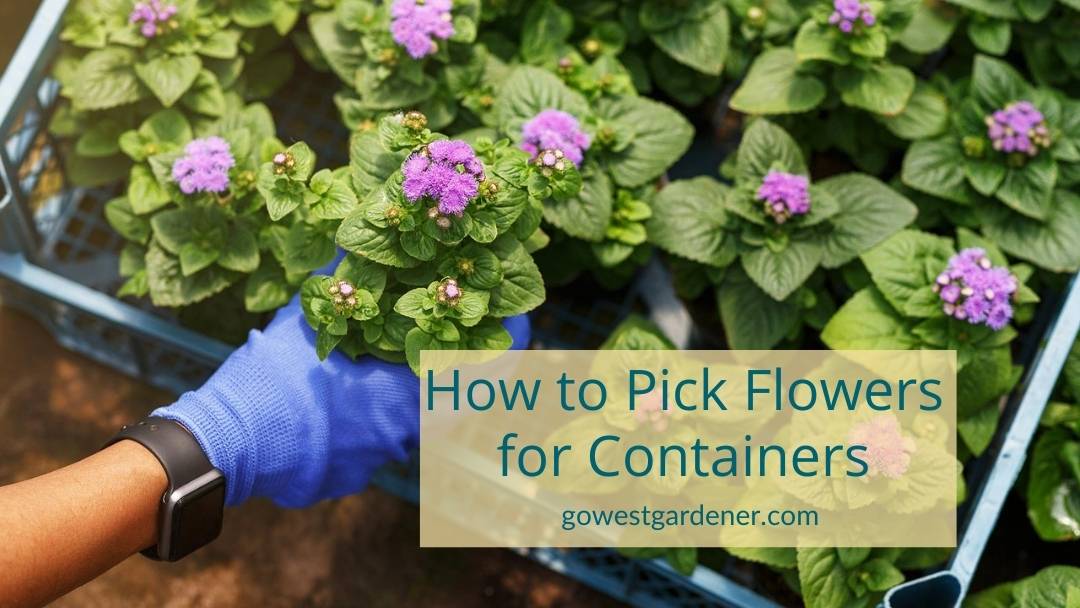
In this tip, you’ll discover 4 proven questions to help you start narrowing down your choices, so you can pick flowers for your planters that are more likely to last — particularly in our tough western growing conditions.
Watch my video below or scroll down for the article.
Here’s what to think about when picking flowers, so your flowers are more likely to last — particularly in tough western states like Colorado and Utah.
#1: How much sun will my planters get where I place them?
Some plants love the sun. In fact, they need the sun in order to give you colorful blooms.
But other plants?
Not so much.
They actually prefer shadier conditions.
Before you go to the garden center, take a look at where your planter will be and ask yourself:
How much sunlight are my pots getting and what times of day?
That way, when you get to the garden center, you can look for flowers that love sun or flowers that prefer shade.
Look at the plant tags tucked in the flowers. The plant tags should tell you whether the flowers like sun, shade or something in between.
If you’re ever unsure of how much sunlight different flowers need, you can always ask at the garden center. People are usually happy to help you.
In western states like Colorado and Utah, our sunlight is more intense on our plants in than other parts of the country because we’re gardening closer to the sun at elevation.
#2: The next question for you is, do you have wildlife in your area?
And specifically, I mean deer.
Here’s why I ask.
Some plants have developed defense mechanisms, so they’re less likely to be eaten by deer.
For example, they may have a scent or a taste that deer don’t like.
If you know that Bambi and his friends like to stroll through your neighborhood like it’s an all-you-can-eat lunch buffet, be sure to ask where the deer resistant flowers are when you go to the garden center.
(Sometimes these flowers are grouped together at the garden center. Sometimes they aren’t.)
The key word here is “deer resistant.”
If an animal is hungry enough, it will eat anything that’s available to it.
Nonetheless, you’ll give yourself a little bit of an advantage if you know that your neighborhood has deer, and you seek out deer-resistant flowers.
Okay, next question:
#3: Do you get really hot summers? Or are you more likely to get summer frosts?
Here’s why I ask.
Some flower plants do really well in the heat. They can handle it like a champ, like the zinnias below.
Other flower plants prefer cooler temperatures and are happier in sweater and jeans weather.
In fact, when temperatures get down around freezing, they’re going to be a lot more forgiving than some other plants (like pansies or violets below).
Seldom are these two the same.
So, if you know you live somewhere hot and you’re putting your flower plants out in the afternoon sun, then you want to ask for “heat tolerant” annuals or “heat resistant” annuals.
But if you know that you live at a higher elevation with a much shorter growing season and you have the chance of much colder temperatures, then you’re more likely to want to ask for “frost tolerant” annuals or “cold hardy” annuals. These are your flowers that are more forgiving at colder temperatures.
Okay, last question to ask yourself to set yourself up for more success with your planters or pots.
And it’s this:
#4: How much energy do you want to put into growing flowers?
All flowers need a little bit of your energy, right?
You need to water your flowers.
You may need to remove the dead blooms.
And you may need to fertilize them from time to time.
But, if you know you’re not-so-great about watering or you’re not-so-great at removing those dead blooms, there are actually flowers you can choose that are almost designed for you.
For example, let’s say that the idea of trimming off dead blooms on a flower sounds like a lot of work to you. (This is known as “dead heading.”)
Well, did you know there are some flowers that lose their petals on their own?
Often times, they’re called “self-cleaning” flowers. They lose their blooms and take care of it all themselves, so you don’t have to do a thing.
When you look at flowers at the garden center, look for words like “self cleaning” or “no deadheading” on their plant tags. (Not every plant tag says it, so it’s okay to ask about self-cleaning flowers too!)
If you know you’re not so great about watering…
You may want to ask about flower plants that need less water.
Or, you may want to invest in planters that contain self-watering reservoirs. You could run mall hoses from your irrigation system (known as “driplines”) straight into your planters or pots.
There are things you can do to pick plants that are much more suited for your lifestyle.
Related tips that may interest you: