by Ann at Go West Gardener | Updated: Sep 12, 2025 | Best Flowers for Colorado, Utah & Similar States
It may seem like a strange time to chat about spring flowers…
… when we have pumpkins and Halloween decorations appearing in stores.
But if you’re interested in growing spring flowers…
Autumn is the ideal time to plant spring bulbs in most parts of the West.
For example:
- In most elevations of Colorado, the ideal times to plant spring bulbs are typically late September and October.
- In northern Utah, the ideal times are usually October and early November.
Yep, you plant these flowers in the fall — not the spring!
Weird, right?
Okay, technically, you plant their bulbs.

Think of a bulb like a battery for the plant.
It stores energy (food and water) for the flower.
It may seem counter-intuitive that you plant spring bulbs in the fall, but:
- Bulbs need to go through a cold period, so they can come up and give you big, showy color in the spring.
- They also need a little time to establish their roots before the ground freezes.
Here are 3 popular spring flowers for western gardens.
These spring flowers offer beautiful pops of color, and they’re relatively low maintenance. (Cheers to that!)
Once planted, these flowers can return for several years with minimal effort.
Tulips
(officially, Tulipa)
This is what tulips look like. They come in a WIDE range of colors.
Tulips bloom in the spring, but not all at one time.
There are early, middle and late spring tulips.
This means that some start blooming earlier than others.
The package of bulbs you buy or the signage at the garden center should tell you when the tulips will bloom (early, middle or late spring).
That way, you can pick bulbs with the bloom at different times, so you can get longer-lasting color.
Tulips like sunny conditions and soil that drains well.
If you have a damp spot where water sits in the ground or if your soil is dense clay, it’s probably not the best place for tulips.
What’s dense clay like, you ask?
Imagine sticking your shovel in the ground, and the soil sticks to your shovel like bubble gum to a shoe.
When clay soil is damp, it’s sticky, heavy and dense. It’s tough for water to drain.
Tulips don’t mind if the ground is on the dryer side during the summer, which is good for our semi-arid summers in the West.
In my opinion, the biggest downside to tulips is…
… that animals LOVE them.
Deer, rabbits, squirrels, voles. Take a number!
In my back garden, squirrels decapitate my tulips every spring, just as the petals are opening.
I’ve tried a variety of suggested remedies, from animal-repellent sprays to cayenne pepper. (Seriously.)
The only thing I’ve found that works is to fence the tulips off.
Not the prettiest look, ahem.
So, if you have critters, you may want to check out the other spring flowers below.
Daffodils
(officially, Narcissus)
These are daffodils. They come in colors like yellow, white, orange, peach or pink.
Typically, daffodils prefer sunny conditions and soil that drains well.
You may be able to get away with a partially sunny spot, but your daffodils may not bloom as well.
In the semi-arid west, you may want to plant your daffodils near a downspout or a low spot in your garden.
Why?
Daffodils tend to be happiest with moist (but not wet) soil.
If the ground is too wet, daffodil bulbs will rot.
Daffodils are not only beautiful, they’re also resistant to many animals.
YESSS!!
Normally, deer, rabbits and other rodents avoid daffodils. That’s a plus if you live in an area with your fair share of critters.
(Daffodils can be toxic to dogs, so keep that in mind if you have fur babies.)
Allium
(commonly known as Ornamental Onion)
Allium flowers add a hint of whimsy to your garden. They look like giant lollipops!
They’re one of my favorite spring flowers.
You can find allium flowers in purple, white and even blue.
Yes, BLUE!

Similar to tulips and daffodils, allium will give you the best show when you plant them in places in your garden that get a lot of sun.
And like the other spring flowers we’ve discussed, allium flowers bloom at staggered times.
Allium are related to onions.
In fact, they’re commonly referred to as “ornamental onions.”
Deer are not big fans of these plants.
Rabbits tend to avoid most allium as well.
When allium flowers are done blooming, you may see gardeners spray-paint the finished blooms.
Check out the photo below for an example.
I think this is a fun trick to highlight the colorful, round shapes after the flower petals fall off.
You also can just snip off the dead blooms.
That way, the plant can focus its energy on recharging its bulb for next season.
If you live in Idaho, Oregon or Washington: Your states have special restrictions on buying allium bulbs. The University of Idaho Extension has a helpful publication explaining the rules for Idaho.
Do you live someplace with really cold winter temperatures?
Some types of tulips, daffodils and allium do better than others in frigid temperatures.
If you have a mountain garden or you live someplace with really cold winters, make sure the bulbs you’re buying grow well in your “plant hardiness zone.”
Not sure what a plant hardiness zone is? Get the scoop here.
Related tips that may interest you:

by Ann at Go West Gardener | Updated: Jun 20, 2025 | Gardening for Pollinators, Gardening Tips and Tricks
A friend asked me: “How do you know if gardening products are really organic?”
Maybe you’ve wondered the same thing.
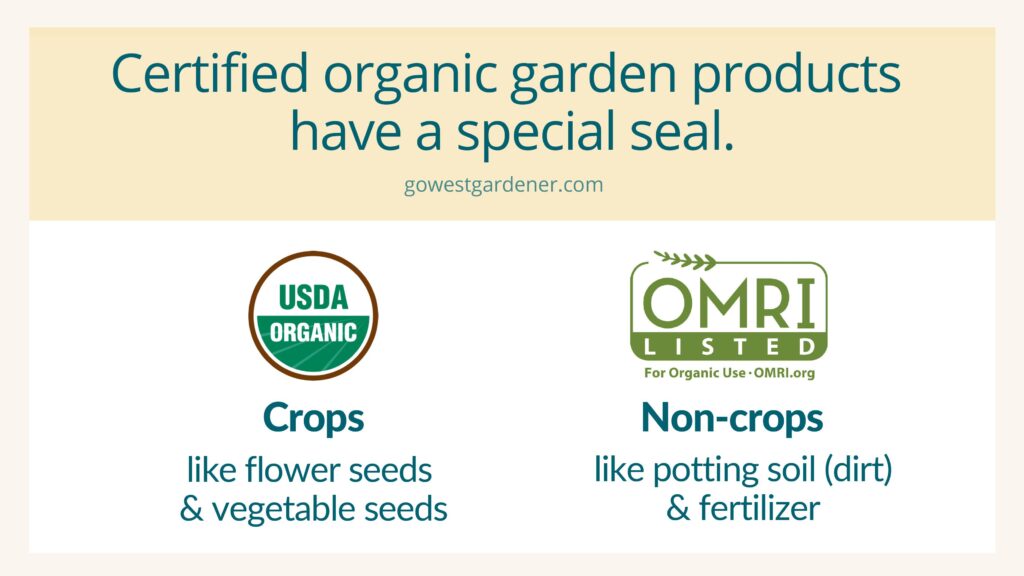
Certified organic garden products have a special seal on their packaging. You can see what the seals look like below.
When you see one of these seals, it means you’re buying products that meet certified organic guidelines.
The seal will either be from the US Department of Agriculture (USDA) or the Organic Materials Research Institute (OMRI).
Flower seeds and vegetable seeds (crops/food) have a “USDA Organic” seal.
This means the final product has undergone a strict organic certification process, according to the USDA website.
No genetic engineering. No synthetic fertilizers (aka, man-made fertilizers). Etc.!
Other garden products have an “OMRI Listed®” seal.
Garden products like fertilizers and potting soils (dirt) are certified through a different organization: the Organic Materials Research Institute—or OMRI, for short.
OMRI is a non-profit that does independent reviews of non-food products to confirm whether they’re organic.
Gardening products with the “OMRI Listed®” seal meet the organic standards for farming and processing.
Look for the seal on the packaging.
It’s helpful to know that these seals aren’t big. And sometimes, they’re in a discreet spot.
Check out example below. Do you see the USDA Organic seal on this packet of zinnia seeds?

Image courtesy of Botanical Interests
What if you just see the word “organic” on the package?
The use of the word “organic” on non-food products is not federally regulated (source: OMRI).
So, just seeing the word “organic” in the words on the package may—or may not—mean that the gardening product is truly organic.
Related topics that may interest you:

by Ann at Go West Gardener | Updated: Oct 20, 2025 | Gardening Tips and Tricks, Western Container Gardening With Flowers
It would be awesome to be named “The Perfect Gardener” after a summer of growing flowers — complete with dancing squirrels and a pitch-perfect choir of cicadas.
But alas, most of us weren’t born with a spade in one hand and a geranium in the other.
So, the next best thing is to find ways to shorten our learning curve for next year.
As we near the end of the summer flowerpot season in western states like Colorado, Utah and Wyoming, it’s a great time to ask…
How’d your flowerpots turn out?
- Which flowers made your heart sing with joy?
- Which flowers were duds?
- What would you do again next year?
- And what would you change?
Now, before your mind starts shouting:
“Ugggghhhhhh, gardening is so much work!!!”
I say:
Keep it simple, baby.
You can do this on your phone with just a few pics.
If you’re feeling ambitious, add in a couple of helpful notes in between sips of your favorite pumpkin spice latte.
Here are 3 ways to keep this simple:
(1) Take a quick photo of each flowerpot with your phone.
Don’t worry about getting the lighting perfect. These photos are just to help you remember what you planted and how your container garden turned out.
If you want to stop here, that’s fine. You’ve got a good visual record for next year.
If you like to stay organized, add the photos to a new album on your phone. Name the album something easy to remember like: Flowers 2022.
Tip: Feel free to use photos you took earlier in the season, especially if that’s when your container garden looked prettiest. Or, if you want to see the growth of your pots, it’s always fun to include a “just planted” image from early in the summer and a late season image (like a before and after).
(2) If you saved your plant tags when you bought your plants, snap photos of those too.
Saving the plant tags is a simple way to keep track of the flower varieties you bought, particularly if:
- You loved a specific flower or
- You don’t want to repeat a specific flower next year
If you didn’t save your plant tags this year, no worries. You can do it next year.
Tip: You also can snap these photos when you plant your containers.
I like to group the plant tags together by flowerpot to make them easier to remember, but you don’t have to be this structured. Here are a few ways to group them:
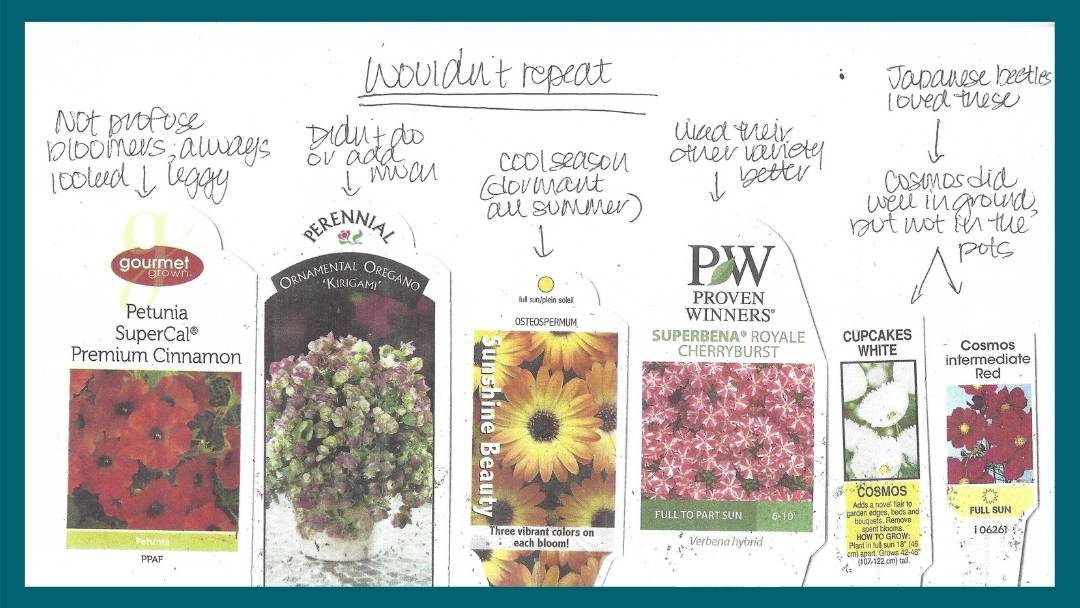
- Group your plant tags into “winners” and “duds” (flowers you loved and flowers you wouldn’t repeat)
- Group your plant tags by flowerpot
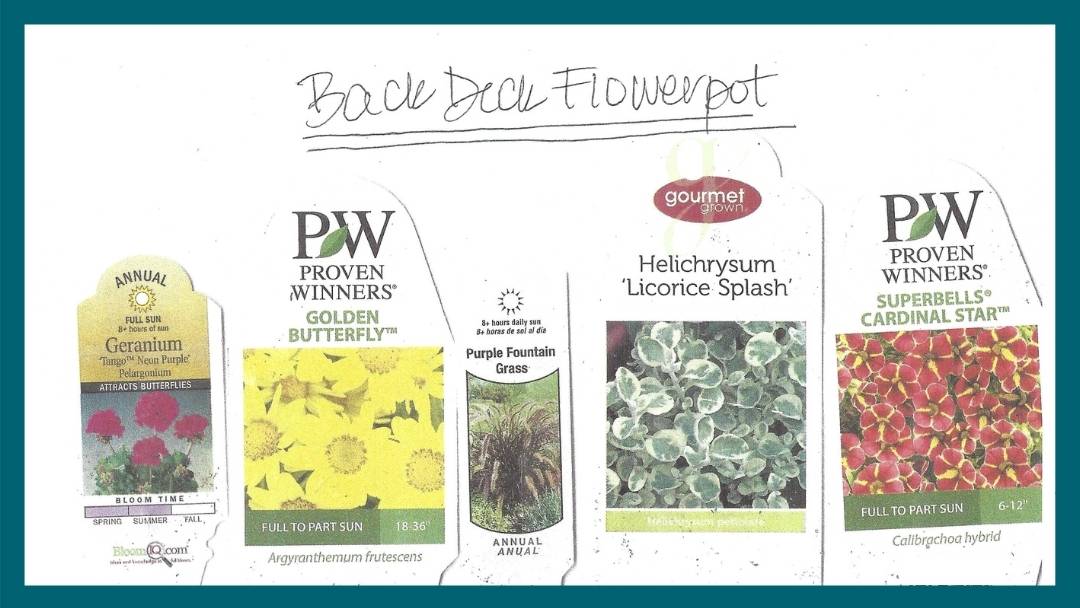
Here’s an example of organizing the plant tags by flowerpot:
If you have a bazillion photos in your phone, like me, and you want to stay organized:
- Add these photos of your plant tags to your “Flowers 2022” folder.
That way, you’ll have them at your fingertips when you go back to the garden center next year. And, you’ll know EXACTLY which flowers you bought.
(3) Jot down anything you want to remember in your Notes app.
It can be helpful to add notes on your phone, so they’re easily accessible next year too.
But, if you prefer to write them out or type them on your computer, feel free to do that instead! You can always take a photo of your notes.
If you’re wondering what to write down, here are a few questions to consider:
- Which flowers did you really like? (Why?)
- Which flowers were duds? (Why?)
- Which flowers were too much work?
- Which flowers got gobbled up by Japanese beetles, deer or other critters?
- What would you do again in future flowerpots?
- What would you do differently?
You don’t have to turn into Leo Tolstoy here and write a 1200-page novel. There’s no need to answer ALL these questions or write notes about every flowerpot.
Just note what you want to remember. Make your thoughts as short as you want.
Don’t know the names of the flowers in your containers? No worries! You can say “the purple flower” or “the lime-green vine.” You’ll have the photo to go with your note, so you can see what it looks like.
(BTW, this is another bonus to saving the plant tags. They help you learn plant names.)
Here are examples of notes I’ve taken:
Now, you’ll have everything easily organized on your phone.
You’ll be able to quickly pull up your photos and notes when you start thinking about planting next spring.
You’ll be able to avoid anything that may have gone slightly awry this summer.
And if you’d like, you can repeat the flowers that looked really, really good.
Because we are all about gardening smarter, not harder, am I right?
Related topics that may interest you:
by Ann at Go West Gardener | Updated: Jan 28, 2026 | Garden design Ideas, Gardening Tips and Tricks, In-ground garden, Waterwise Gardening in the Intermountain West
You may be in the heart of winter, but that doesn’t mean your garden has to look boring!
Chances are, when you’re out walking your dog or getting a little fresh air, you’ve noticed a neighbor’s home that catches your eye.
You know the one.
It’s the house or apartment complex where you can’t help but stop and look. Their landscaping looks soooo good in the fall and winter.
Heck, even your dog wants to stop and take a look. (Or, at least take a lil’ sniff.)
If you want a pretty winter garden too….
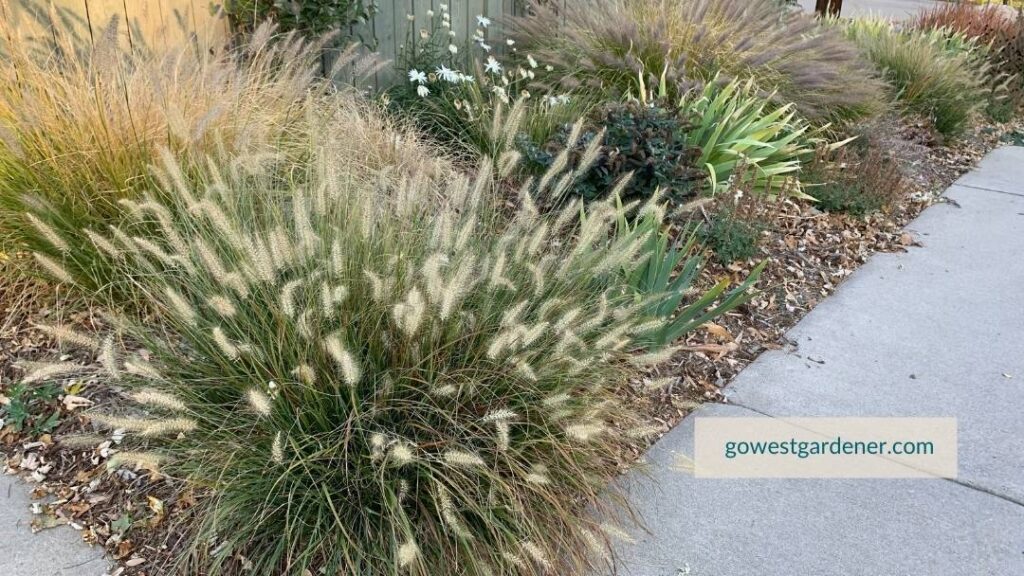
One of the easiest ways to make your garden look good in the winter is to plant ornamental grasses.
Ornamental grasses add a “wow” factor to winter gardens.
Their feathery plumes or seed heads will glow in the winter light. When the wind blows, you’ll get a wonderful flowing motion and a whispering sound. And they can add structure and height to your garden.
In garden lingo, this is known as creating “winter interest.” Even though it’s winter, you still have plants that look pretty.
Best of all, ornamental grasses are easy to grow.
Here are helpful things to know about ornamental grasses:
1) Ornamental grasses tend to be low maintenance.
You’ll likely cut them back once a year, but that’s about it. You don’t have to fuss over them.
2) Grasses tend to bounce back well from our tough weather: gusty winds, hail, surprise snowstorms… Gotta love the intermountain west!
3) They tend to grow well in our poor western soils, so they’re less work.
4) Many grasses are “deer resistant.”
You shouldn’t have to worry about your grasses disappearing thanks to your neighborhood Bambi.
5) Some grasses don’t need much water, which is awesome if you live in a semi-arid climate like Colorado or Utah.
PRO TIP: Some grasses DO need regular watering, so don’t assume your grass is “drought tolerant.” Do a little research first or ask when you buy it.
6) There are lots of interesting grasses to choose from!
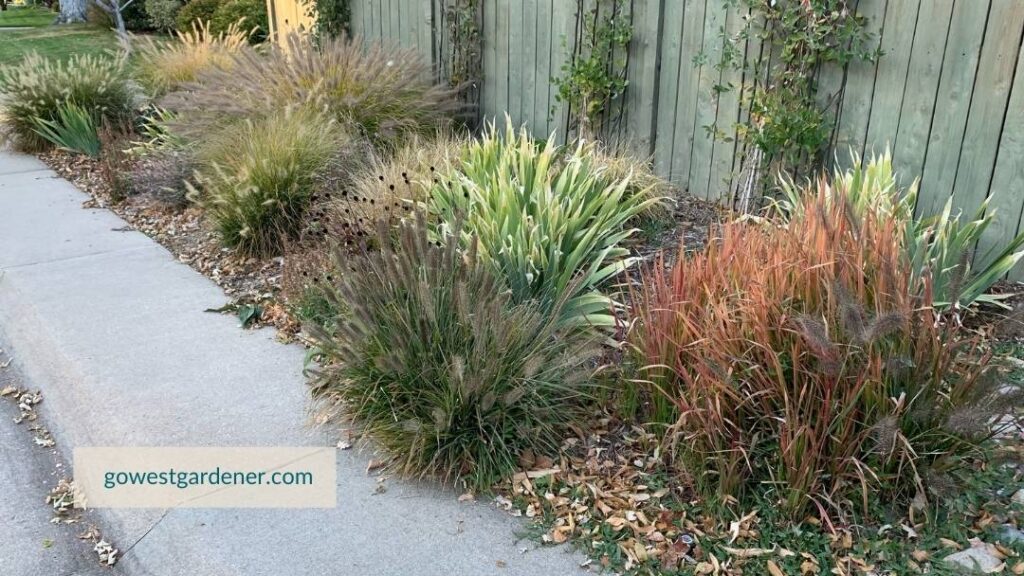
You can find the perfect look: from round, mounded grasses, to narrow, column-like grasses. They come in all sizes and a range of colors.
You can see examples in the fall garden below:
While you don’t plant grasses in the winter, our coldest months are a great time to take photos of grasses you like.
When you’re out walking your dog or dashing to the grocery store, pull out your phone and snap a pic if you see grasses you think are pretty in the winter. Create a folder on your phone called “Garden Inspiration.” Add your pics to that folder.(If you have a million photos on your phone like me, this makes it easy to find your photos when you head to the garden center.)
It’s 100% okay if you don’t know what the grasses are!
Check out this post for 6 popular western grasses and what they look like in the winter. Hopefully, this will make it easier to figure out which ones you like.
Plus, you can take your photos with you when you buy flowers in the spring. The employees at local, independently-owned garden centers are usually happy to help you identify plants.
One more tip to make your garden look good in the winter…
I used to cut down the ornamental grasses in my garden in the fall. I wanted my winter garden to look tidy.
But I’ve come to appreciate how pretty plants can look when they’re left standing over the winter. Often times, this can help them survive the winter better too. And it can create a little habitat for wildlife, like migrating birds.
So, if you already have ornamental grasses and you’ve been cutting them down in the fall, no worries! But next year, skip the chopped look below.
Leave your grasses standing through the winter.
If you have a grass that needs to be trimmed back, prune it in the spring when you start seeing new growth coming up. It’s an easy way to make your winter garden look prettier. Plus, it’s good for the health of your garden and for pollinators too.
Related tips that may interest you:
by Ann at Go West Gardener | Updated: Jan 28, 2026 | Gardening Tips and Tricks, In-ground garden
I originally published this article in March 2022. Enjoy!
Spring flowers are starting to pop from the ground like eager party guests who want to be the first to arrive… even as Mama Nature sends us a few more snowstorms in Colorado. (Good times.)
As we ride the weather roller coaster between winter and spring, it’s a good time to ask:
Would you like your garden to look more beautiful next winter?
I’m talking about a winter garden that has neighbors stopping to admire your landscape… or simply a garden that makes your heart sing every time you look outside.
If yes, spring is the time to act.
Many of the plants that add interest to winter gardens are best planted in April, May and June.
Yep, the months when the last thing you want to think about is winter!!
Here are two examples:
Ornamental grasses
Ornamental grasses are showy landscape grasses that can add a big “wow” factor to winter gardens (and fall gardens too). Their feathery plumes and seed heads glow in the winter light. These grasses dance in the wind, adding a soothing whispering sound to gardens.
The irony is the best time to plant many ornamental grasses is when you crave color: spring!
“Warm season” ornamental grasses (the grasses that grow during the time of year that you wear sandals) are best planted in May and June. This is when they’ve actively started growing, but well before you see their seed heads. Not to mention, the weather usually isn’t too hot yet.
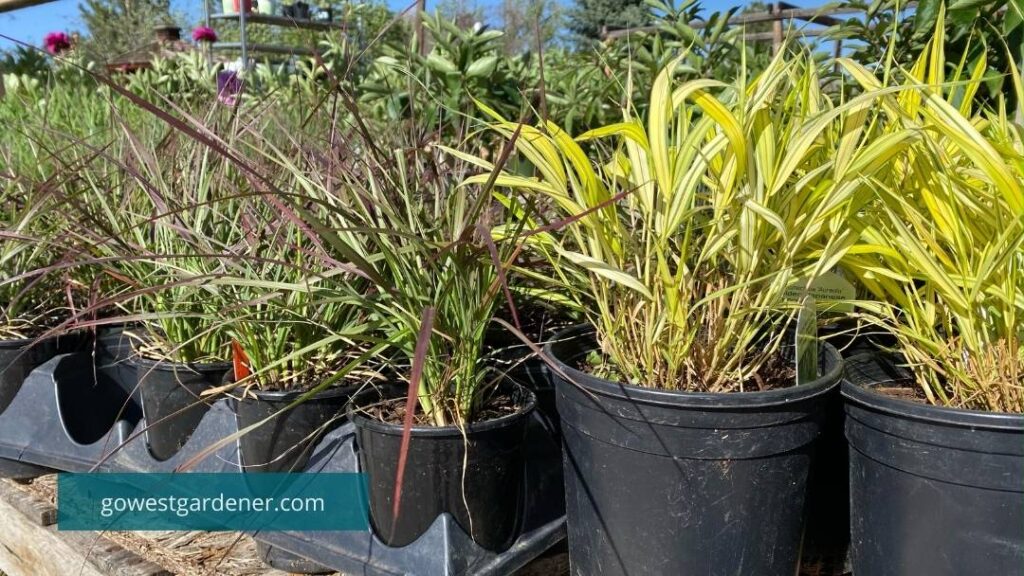
Pro tip: This is when grasses may look a little “meh” at the garden center. They won’t have their showy plumes yet, but don’t let that deter you. Buy them in the late spring, so you can create winter interest later in the year.
Evergreen shrubs
The same timing is true with evergreen shrubs—woody plants that keep most of their needles or leaves during the winter.
Spring is the ideal time to plant evergreen shrubs in western states like Colorado. That way, they have all summer to settle in before you find yourself reaching for mittens again.
(Typically, you can plant evergreen shrubs in the early fall too, but with fall planting, evergreens are more at risk for not surviving the winter.)
With spring approaching…
Now’s a good time to think about what you may want to plant, so your garden shines next winter.
Related tips that may interest you:
by Ann at Go West Gardener | Updated: Jan 9, 2025 | Best Flowers for Colorado, Utah & Similar States, Garden design Ideas, In-ground garden, Waterwise Gardening in the Intermountain West
Put your hand up if want a pretty winter garden!
Ornamental grasses can make your winter garden look good. They add visual interest to your winter landscape (aka, “winter interest”), and they’re easy to grow.
But how are you supposed to know which grasses to pick? A lot of grasses look similar, right?
In today’s tip, I want to give you a peek at 6 popular ornamental grasses — and what they look like in winter gardens in the semi-arid West. That way, you can start figuring out which ones you like.
Please note, if the conditions are right, some grasses will spread their seeds like a fairy godmother tossing pixie dust. So, there are parts of the country where some of these grasses may be considered invasive. When you buy grasses, ask the store whether they’re allowed where you live.
Blue Grama Grass (Bouteloua gracilis)
These ornamental grasses have horizontal seed heads that look like eyelashes. Aren’t they so cool?
Blue grama grass tends to hold up very well to winter snowstorms.
Blue grama is the state grass of Colorado. It’s native to many states, and it’s drought tolerant. It happily grows in areas that get just 10 to 15 inches of annual rainfall. So, along the Front Range of Colorado, it shouldn’t need much supplemental watering, if any.
Blue grama grasses could be a great fit for you if:
- You have a dry, sunny spot in your landscape that doesn’t get much moisture
(like a hot, western-facing or southern-facing section of your yard) - You’re planning a low-water landscape (aka, a waterwise garden)
- You’re known to forget to water (no judgment!)
- You want to plant a native grass.
Water this grass well the first season. This helps it get established in your garden.
After that, it shouldn’t require much attention from you.
Pro tip: If your garden gets regular moisture or has a wetter area, blue grama grass may not be the right ornamental grass for you. My understanding is moisture can turn it into a happy seed spreader.
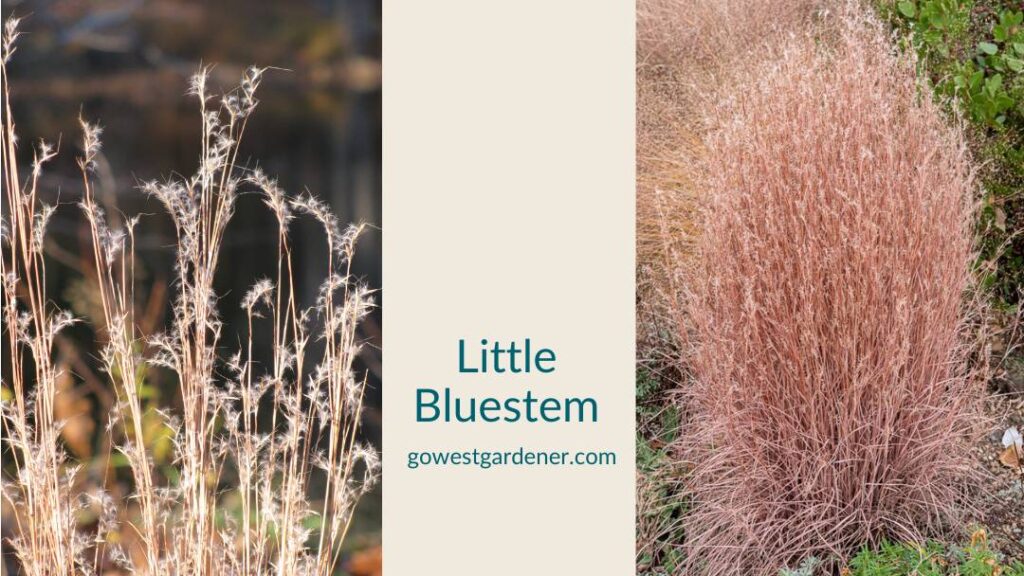
Little Bluestem Grass (Schizachyrium scoparium)
Typically, little bluestem grass grows in an upright shape. This makes it ideal for a variety of smaller settings, like compact gardens.
It doesn’t need much water to thrive, and it can handle clay soils (dirt) like a champ.
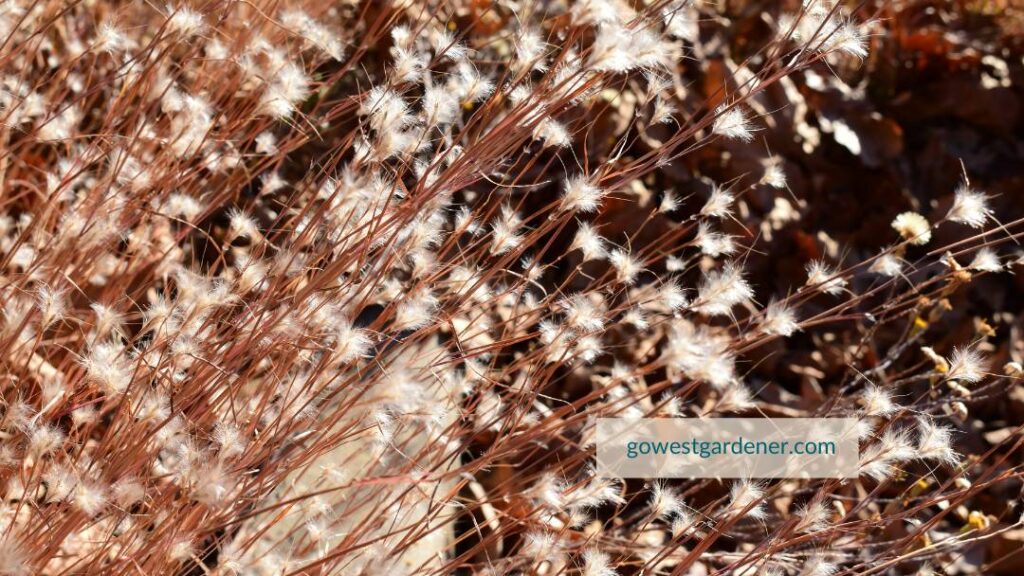
Little bluestem has a bluish-green color in the summer. But in the fall and winter, it can turn a reddish-bronze color and get airy seed heads. The winter color will vary slightly by the type of little bluestem you choose. (Some popular selections include: ‘Standing Ovation,’ ‘Blaze’ and ‘Prairie Blues.’)
This lovely grass is native to the majority of the United States, including Colorado, Utah, Wyoming and Idaho.
Switch Grass (Panicum virgatum)
Switch grass may not be the showiest grass for a winter garden. However, it can be really pretty in the summer and fall, so I couldn’t resist including it on this list. It’s also a native grass to Colorado.
Generally, switch grasses tend to prefer more moisture.
If you’d like a more drought-resistant type, look for the switch grass known as ‘Shenandoah.’ In the fall, its leaf blades turn burgundy. It gets delicate, pink seed heads in the fall. They lose their color in the winter, but they still have a lovely airiness to them.
Maiden Grass (Miscanthus sinensis)
In my opinion, maiden grass is one of the showiest winter grasses. It also likes more water. So, if you live in Colorado, Utah or another part of the semi-arid West, look for spots in your landscape that get more moisture, like near a downspout or in a low area where water gathers.
Maiden grasses often have soft, feathery plumes. In the winter, their plumes look like fluffy feathers spilling out of a pillow. They glow in the winter sun.
Some varieties of maiden grass can grow up to 5 to 6 feet tall and nearly as wide, so plan accordingly when you’re deciding where to plant this grass.
Want a similar size grass that uses less water?
If you’re thinking, “Ooooh, I like this size of maiden grass, but I want an ornamental grass that doesn’t need as much water,” check out giant sacaton grass (Sporobolus wrightii) instead. Giant sacaton is about the same size as maiden grass (it’s big!), but it thrives with very little moisture.
Plus, giant sacaton grass is a regional native. This grass is native to states like Texas, New Mexico, Arizona, Utah and California.
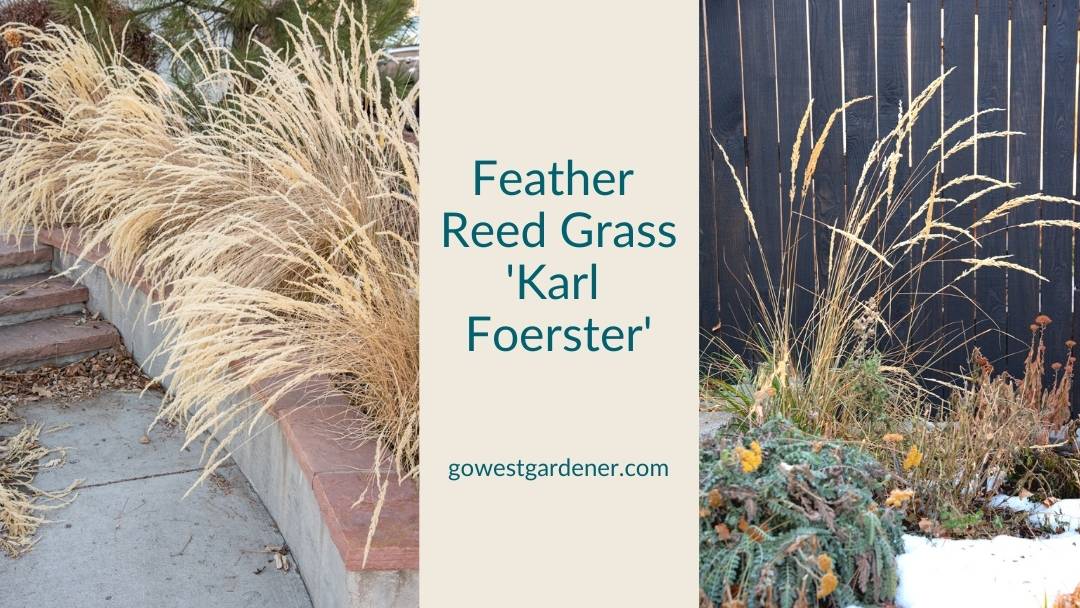
Feather Reed Grass (Calamagrostis)
Feather reed grass is another grass that glows in a winter garden.
There is one type of feather reed grass — known as ‘Karl Foerster’ (pictured above) — that is very popular. You’ll see it in a lot of landscaping around homes and shopping centers.
Feather reed grass grows in an upright direction (like a column), making it a good grass for a smaller garden or a garden with limited space. It’s also very pretty against a darker background, like an evergreen tree or a stained fence.
If you like the look of feather reed grass but you want one that’s more unique, look for Korean feather reed grass instead. The seed plumes are soft and pretty. Korean feather reed grass can grow in partly shady conditions too. In winter, the one drawback to Korean feather reed grass is that it doesn’t stand up as well to heavy snows as some other grasses.
Hardy Pampas Grass (Erianthus ravennae)
Hardy pampas grass is a big guy! It can grow 10-12 feet tall and 4-6 feet wide. To show you how tall it can grow, I asked my pawtner-in-crime to join me in the photo below. She wasn’t as excited about the photo opp as I was.
Pampas grass is an interesting grass to consider if you have:
- A big yard that could use a focal point
- A deep garden that could use some height in the back
- An area of your yard where you want to draw your eyes away from something (like an electrical pole)
If you like the look of this ornamental grass but it’s too big for your garden, there are smaller versions of pampas grass too.
Where to learn more about ornamental grasses
The Colorado State University Extension has a helpful fact sheet on ornamental grasses (PDF), including how big different grasses grow, how much water they prefer (dry vs regular irrigation), and how high they can go in elevation.
Related tips that may interest you:
by Ann at Go West Gardener | Updated: Sep 12, 2025 | Gardening Tips and Tricks, In-ground garden, Western Container Gardening With Flowers
When you’re strolling through the garden center or dashing into the grocery store and all those pretty flowers are smiling up at you, it’s hard not to choose the showiest flowers you see.
“Well, helloooooo there.”
But if you’d like your fall flowers to last longer, hold up!
There are ways to choose flowers that last longer… and hint, this means resisting the urge to buy the flowers that look the prettiest.
TIP 1: Look for the flower plants with a lot of new buds (rather than just open blooms)
Do you see the yellow mum plant below? The showy, yellow flowers have opened, and they look beautiful.
But because these flower blooms have already opened, they likely won’t last as long when you get them home. They’ve already used up some of their bloom time.
Instead, look for plants that resemble this second set of mums (below).
Do you see how this plant has lots of new buds?
These flowers should last longer for you when you get them home because these flower blooms haven’t opened yet.
You can use this tip when buying annuals OR perennials
I use this tip when I pick annuals (the one-season flowers) for my flowerpots in the spring and fall.
I also use it when buying perennials (the flowers that come back every year) for my western garden.
If you want your flowers to last longer, it helps to look for plants with new buds. They don’t always look the prettiest in the store, but that’s just because they haven’t fully opened yet.
But what if you aren’t sure what color the flowers are going to be?
Great question! Sometimes it’s hard to know what the color is when the flowers haven’t opened yet.
Tip #2: There are several ways to figure out flower color
- Look for any open flowers on the plant.
- Check the plant tag to see if the plant tag lists the color. Sometimes, the flowers have the color in their name or in the photo on the tag.
- You can check the nearby plants. If the same type of flower has already opened, you can see the color.
Tip #3: For many flowers, their blooms don’t last as long when it’s hot
Where I live in Colorado, we can get heat waves well into the fall. It may be the same where you live too.
If you want to buy fall flowers — like mums — and you want them to last as long as possible, you may not want to buy them the week that blazing hot temperatures are in the forecast.
Those flowers tend to go through their blooms quickly when it’s hot, meaning they won’t last as long.
Just a lil’ something to think about!
Related tips that may interest you: