A friend asked me: “How do you know if gardening products are really organic?”
Maybe you’ve wondered the same thing.
Certified organic garden products have a special seal on their packaging. You can see what the seals look like below.
When you see one of these seals, it means you’re buying products that meet certified organic guidelines.
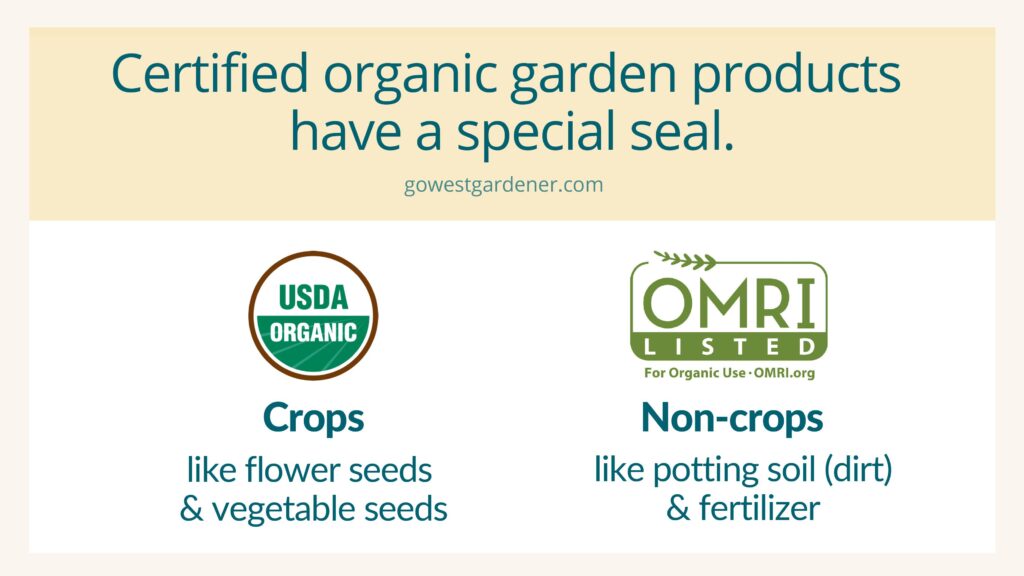
The seal will either be from the US Department of Agriculture (USDA) or the Organic Materials Research Institute (OMRI).
Flower seeds and vegetable seeds (crops/food) have a “USDA Organic” seal.
This means the final product has undergone a strict organic certification process, according to the USDA website.
No genetic engineering. No synthetic fertilizers (aka, man-made fertilizers). Etc.!
Other garden products have an “OMRI Listed®” seal.
Garden products like fertilizers and potting soils (dirt) are certified through a different organization: the Organic Materials Research Institute—or OMRI, for short.
OMRI is a non-profit that does independent reviews of non-food products to confirm whether they’re organic.
Gardening products with the “OMRI Listed®” seal meet the organic standards for farming and processing.
Look for the seal on the packaging.
It’s helpful to know that these seals aren’t big. And sometimes, they’re in a discreet spot.
Check out example below. Do you see the USDA Organic seal on this packet of zinnia seeds?

Image courtesy of Botanical Interests
What if you just see the word “organic” on the package?
The use of the word “organic” on non-food products is not federally regulated (source: OMRI).
So, just seeing the word “organic” in the words on the package may—or may not—mean that the gardening product is truly organic.
Related topics that may interest you:
- Creating a native pollinator garden in Colorado
- How do I attract bees and butterflies to my garden?
- Why bees and butterflies are like puppies and kittens